 The Ottoman Empire Returns – Turkey, the Beast, and the Origin of the Antichrist
In-Depth Summary
The Bible doesn’t hand us a checklist of modern nations in which we can simply look up the names of the end-time powers. Yet Scripture describes something that goes much further: kingdoms rise and fall, structures of power shift, old powers can become visible again, and in the end a final power appears that raises itself directly against God.
In his visions, Daniel sees a succession of kingdoms replacing one another. Then, in Daniel 7, a fourth beast appears that is exceptionally terrifying. Ten horns come out of this beast, and afterward a small horn appears that speaks great words against the Most High and wages war against the saints.
Daniel 7:23-25
The prophecy speaks of a fourth kingdom, out of which ten kings arise, followed by another king who speaks against the Most High and persecutes the saints.
Here we immediately see an important biblical principle: a king can be the personal representative of a larger kingdom or system of power. The person and the system are not identical, but they are connected.
This same principle resurfaces in Revelation. John sees a beast with seven heads and ten horns. The beast receives its power from the dragon, is admired by the world, speaks blasphemous words against God, and wages war against the saints.
Revelation 13:1-8
The beast receives power from the dragon, is given authority over nations, and wages war against the saints.
Within this study it is therefore argued that the first beast of Revelation 13 does not refer to a single individual alone, but to an antichristian power structure that is ultimately embodied by one person. That person is the final Antichrist.
This is exactly where Revelation 17 becomes extraordinarily important. John is told that the seven heads represent seven kings. Then an eighth is mentioned, one who arises out of the seven.
Revelation 17:9-11
The seven heads are explained as seven mountains and seven kings. Then an eighth is mentioned, arising out of the seven.
The eighth, then, does not appear out of nowhere. He is connected to the earlier power line. That opens the possibility that a former power structure, after historically disappearing, can become visible again in an altered form.
Within this prophetic reading, the Ottoman Empire is therefore no minor historical footnote. It represents a possible historical foreshadowing of the final power structure. The Ottoman Empire was for centuries a dominant power in the Middle East, ruled Jerusalem for roughly four centuries, and then vanished as an empire.
But the geographical heart of that empire did not vanish.
Anatolia remained. Turkey remained. And the historical memory of the Ottoman Empire remained.
This creates a striking connection to the words of Revelation 17 about a power that was, is not, and will appear again.
Revelation 17:8
The beast was, is not, and will rise up out of the abyss.
The Bible does not say literally, “The Ottoman Empire will return.” We should not read that into the text. But when a vanished historical power structure later reappears in an altered form, that does fit the prophetic pattern that Revelation shows us.
Ezekiel 38-39 adds to this. There, Gog appears as the leader of a great coalition that marches against Israel. Among the regions named are Meshech, Tubal, and Beth-Togarmah.
Ezekiel 38:2-6
Gog is named as a prince, and various peoples are named as allies in the coming attack.
Several of these names are historically linked to Anatolia and the regions surrounding present-day Turkey. That makes an Anatolian power base within the prophetic scenario particularly interesting.
The central thesis of this article is therefore that Turkey may form the geographical and political core of a future revival of the old Ottoman power structure, out of which the beast power and its leader (the Antichrist) could ultimately arise.
The Antichrist need not literally be the president of Turkey. He does not even need to hold Turkish nationality. What matters is the power structure he arises from and ultimately represents. Turkey, in any case, deserves to be watched closely.
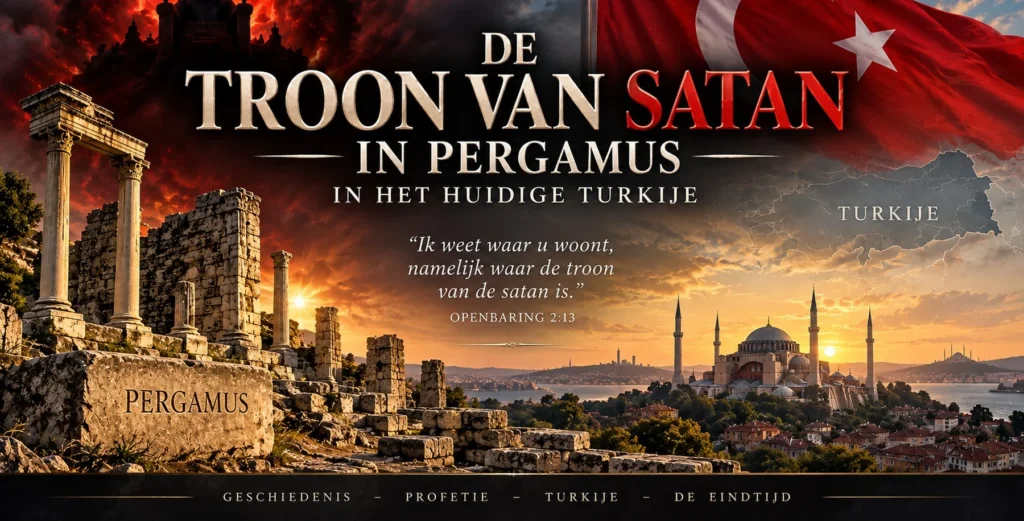
The Throne of Satan in Present-Day Turkey
In His message to the church of Pergamum, Yeshua mentions a striking detail:
Revelation 2:13
“I know where you dwell, where Satan’s throne is.”
Pergamum lay in Asia Minor, in present-day Turkey. Yeshua directly links this place to a center of satanic spiritual and religious power. This doesn’t mean the Bible states that modern Turkey is literally Satan’s dwelling place, but it is striking that a “throne of Satan” is named precisely in this region.
This takes on extra meaning when we see that Revelation later speaks of the beast, its power, and its ultimate world dominion (Revelation 13; 17). That’s why the geographical and historical line running from Asia Minor to the later Ottoman power base deserves serious attention when studying the end-time prophecies. The Bible does not name Turkey directly as the land of the Antichrist, but Yeshua’s reference to Pergamum makes this region’s role prophetically remarkable.
Within this study, the central conclusion is therefore:
The old Ottoman power base can be revived in a new form, Turkey can take a central position within it, and the eventual Antichrist can emerge from this revived power structure.
Key Conclusions of This Study
- Daniel describes a succession of kingdoms and a final power structure that raises itself against God (Daniel 7).
- The small horn in Daniel 7 is a personal ruler connected to the final power structure (Daniel 7:8, 20-25).
- The first beast of Revelation 13 receives its power from the dragon and exercises authority over nations (Revelation 13:1-8).
- The beast’s seven heads are linked in Revelation 17 to seven kings (Revelation 17:9-10).
- According to Revelation 17, the eighth arises out of the seven (Revelation 17:11).
- The historical Ottoman Empire was for centuries a dominant power structure around Jerusalem and the Middle East.
- The Ottoman Empire vanished as an empire, but Anatolia and present-day Turkey remained.
- A future revival of an Ottoman or neo-Ottoman power structure fits within the prophetic possibility of a power that reappears.
- Ezekiel 38 names Gog as leader of a great coalition against Israel (Ezekiel 38:1-6).
- Meshech, Tubal, and Beth-Togarmah give the study a striking Anatolian geographical component.
- Within this interpretation, the Antichrist could arise from a revived power structure with its historical roots in Ottoman territory.
- Gog and the Antichrist need not be the same person, but they can both be part of the same eventual antichristian power development.
- The final judgment on this power comes from God Himself (Ezekiel 38:18-23; Revelation 19:19-21).
Yeshua HaMashiach is, in the end, the Victor.
In-depth explanation
1. Daniel Gives Us the Key to the End-Time Power
Anyone who wants to understand the Antichrist must start with Daniel. Revelation, after all, uses the same imagery as Daniel. The beast of Revelation doesn’t emerge from an entirely new prophetic tradition; John builds on what Daniel had already seen.
Daniel sees four great beasts. The fourth beast is especially terrifying and has ten horns.
Daniel 7:7-8
The fourth beast is exceedingly dreadful and has ten horns. Then a small horn appears.
The angel then explains that these beasts represent kings and kingdoms.
Daniel 7:17
These four great beasts are four kings who will arise out of the earth.
Here, then, we have a fundamental biblical key: a beast can represent a kingdom, and the horn can represent the ruler who arises out of that kingdom.
This pattern returns directly in Revelation.
2. The Beast of Revelation 13 Is a Power Structure
John sees a beast rising out of the sea with ten horns and seven heads.
Revelation 13:1
John sees a beast with seven heads and ten horns.
The beast then receives its power from the dragon.
Revelation 13:2
The dragon gives the beast its power, its throne, and great authority.
This shows that behind the visible political power, an invisible spiritual power is at work.
The beast, therefore, is not merely a human government. It is a political power that is ultimately backed by satanic power.
This is the antichristian power structure under the Antichrist’s leadership.
3. The Seven Heads and the Eighth
Revelation 17 then gives us the explanation of the seven heads.
Revelation 17:9-10
The seven heads are seven mountains and also seven kings.
Then comes the most striking part:
Revelation 17:11
The beast that was and is not is himself also an eighth, and is of the seven.
Here an image of continuity emerges.
The eighth is out of the seven.
Within this study, this is seen as an indication that the final power has a relationship with earlier power structures. It need not be an identical state that simply reappears. It can be an old power line that comes back to life in a new form.
And this is precisely where the history of the Ottoman Empire becomes relevant.
4. The Ottoman Empire – A Power That Was
The Ottoman Empire, for centuries, formed an enormous power structure spanning Anatolia, the Middle East, parts of Europe, and North Africa.
For this study, what matters most is that the Ottomans ruled Jerusalem for roughly four centuries.
Then the empire vanished.
The sultanate was abolished, the caliphate disappeared, and the modern Turkish republic arose.
But Anatolia remained.
The state changed. The empire vanished. The geographical core remained.
This makes it possible, within this study, to view the Ottoman Empire as a historical manifestation of a power structure that can later reappear in a different form.
5. “Was, Is Not, and Will Rise”
Revelation uses a striking phrase:
Revelation 17:8
The beast was, is not, and will rise up out of the abyss.
This is one of the most important texts within this interpretation.
- Was: a great power structure existed.
- Is not: that power structure disappears.
- Will rise: the power appears again.
This need not mean that the Ottoman Empire literally regains the same name and borders.
A future revival could instead take on a new shape: a regional alliance, a political union, a military bloc, or a power center that brings various former Ottoman territories back under its influence.
The old empire need not literally return in order for the old power structure to become visible again.
6. Why Turkey May Hold a Key Position
Present-day Turkey lies at the heart of Anatolia and therefore forms the geographical core territory of the former Ottoman Empire.
It is therefore not unreasonable, when considering a possible future revival of this power structure, to look precisely at Turkey.
This is not solely about national borders. Power can be restored through influence, military cooperation, economic dependence, religious ties, and regional alliances.
A future power structure could therefore grow larger than present-day Turkey.
Turkey could be the core; the eventual power structure could become far larger.
7. Ezekiel 38 Sets Gog Against Israel
Ezekiel 38 then presents another important prophetic line.
Ezekiel 38:2-3
Gog is named as prince and leader of Magog.
Gog marches against Israel with a great coalition.
Ezekiel 38:8
Gog comes against the land that has been restored from the sword, whose people are gathered from many nations.
The prophecy then names various allies.
Ezekiel 38:5-6
Persia, Cush, Put, Gomer, and the house of Togarmah are named among the allies.
For this study, Beth-Togarmah is especially interesting, alongside Meshech and Tubal. These names are historically linked, in geography, to regions in and around Anatolia.
This doesn’t produce mathematical proof that “Turkey equals Gog,” but it does produce a geographical indication that deserves serious investigation within the larger scenario.
8. Gog and the Antichrist
An important distinction is needed here.
Ezekiel does not literally call Gog “the Antichrist.” We therefore cannot say that the text teaches this directly.
But within the broader prophetic synthesis, Gog can be linked to the same antichristian power development.
Gog could be the military leader of the coalition, while the Antichrist is the political and personal representative of the ultimate beast power.
That also fits the broader biblical pattern in which different leaders and power structures cooperate within one larger rebellion against God.
9. The Antichrist Arises From the Revived Power Structure
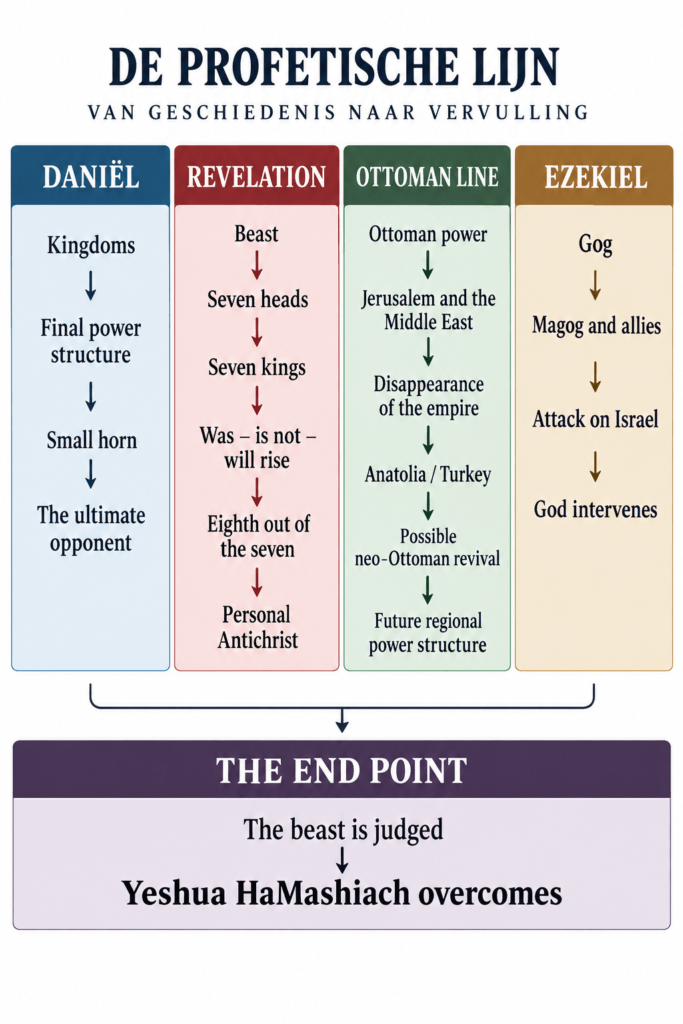
Now the different prophetic lines converge:
- Daniel shows a final power structure and a personal ruler who arises from it.
- Revelation shows the beast, and then the eighth who arises out of the seven.
- Ezekiel shows Gog and a great coalition marching against Israel.
- History shows the Ottoman Empire as an enormous power that ruled over a large part of this geographical world for centuries and then disappeared.
- Anatolia, however, remained as the geographical center.
This is why a strong prophetic line of investigation emerges within this interpretation:
The Ottoman Empire was a historical power structure. It vanished as an empire. The geographical core remained in Anatolia. A future revival could once again form a great regional power structure. Out of that structure, the personal Antichrist could ultimately arise.
10. Daniel 9 and the Final Ruler
Daniel 9 forms an important additional text. There, a coming prince is mentioned, along with a period in which a covenant is confirmed.
Daniel 9:27
The prophecy speaks of confirming a covenant for one week, and then breaking it in the middle of that period.
Within a futurist reading, this is linked to the final seven-year period.
The final ruler appears here as someone with enormous political power who ultimately breaks the covenant and brings the prophetic crisis to its climax.
11. The Man of Lawlessness
Paul describes this same final rebellion from a different angle.
2 Thessalonians 2:3-4
Paul speaks of the man of lawlessness, who exalts himself above everything called God and sets himself up in the temple of God.
Here again we see that the final opponent is both personal and spiritual.
He is not merely a political system. He is a man who ultimately represents that system and exalts himself above God.
This fits with the line already seen in Daniel and Revelation.
12. The Antichrist as the Personal Manifestation of the Beast
It’s therefore important to distinguish between three things:
- Satan – the spiritual source of the power (Revelation 12:9; 13:2).
- The beast – the antichristian political power structure (Revelation 13:1-8).
- The Antichrist / man of lawlessness – the personal ruler who ultimately embodies this power (2 Thessalonians 2:3-4).
This study therefore does not claim that the Ottoman Empire itself was the Antichrist, or that present-day Turkey is the beast.
The idea is that the historical power line can reappear and eventually produce a person who fully embodies this power.
13. Turkey’s Role in This Scenario
Turkey holds a special position within this interpretation because it lies geographically right at the heart of Anatolia.
It is also the core territory of the former Ottoman Empire.
If a future regional power structure emerges that once again brings parts of the former Ottoman sphere of influence under a single political or military authority, Turkey would therefore be a natural candidate as its power center.
This does not mean that every current development is automatically a prophetic fulfillment.
But it does mean that the possibility of a Turkish or Anatolian role in the final power structure deserves serious investigation.
14. The Power Against Israel
The prophetic texts show that Israel holds a central place in the end-time confrontation.
Ezekiel 38:16
Gog comes up against God’s people Israel like a cloud covering the land.
This makes the relationship between a future power structure and Israel prophetically very significant.
Within the scenario of this study, this means that a future revival of Ottoman influence must be viewed not only as a geopolitical phenomenon, but also against the backdrop of the biblical prophecies concerning Israel.
15. God Himself Intervenes
Ezekiel’s prophecy does not end with Gog’s victory.
Ezekiel 38:18-23
When Gog marches against Israel, God Himself intervenes. The earth shakes, great upheaval follows, and God makes Himself known in judgment.
This is essential.
The hostile coalition may be great, but it is not greater than God.
16. Revelation Shows the Same Ending
Revelation likewise shows that the beast does not win in the end.
Revelation 19:19-21
The beast and the kings of the earth gather together against Him who sits on the horse, but the beast is seized and judged.
This brings the full prophetic line together.
 ge 13 sep 2026, 04 00 08" width="478" height="717" />
17. Why This Is More Than Speculation
A distinction must be made between speculation and a biblically grounded interpretation.
We cannot prove that Revelation 17 refers directly to the Ottoman Empire. The Bible doesn’t mention that empire by name.
But we can establish that the Bible speaks of:
- a succession of kingdoms;
- a final power structure;
- a personal ruler;
- a beast that reappears;
- an eighth that arises out of the seven;
- a great coalition against Israel;
- Gog as leader of that coalition;
- and, ultimately, God’s judgment.
When history is then examined, it turns out that the Ottoman Empire was indeed an enormous power structure that exercised great influence for centuries in precisely this geographical world.
The Ottoman/Turkish line is therefore not a random idea pulled out of thin air. It is an interpretive synthesis that seeks to connect biblical prophecy with historical development.
18. The Important Warning
Still, there is one mistake we must avoid: we should never place our interpretation above Scripture.
The Bible does not say literally, “The Antichrist will come from Turkey.”
What we can say is that the combination of the prophetic power line, Ottoman history, Anatolia, Ezekiel’s geographical indicators, and the future revival of a vanished power structure makes this possibility very serious.
It is therefore wiser to speak of a strong prophetic indication and line of investigation than to claim there’s a verse in which the name Turkey appears literally.
19. The Final Victory Belongs to Yeshua
However powerful a future revival becomes, it does not get the final word.
The Antichrist receives power, but his power is temporary.
2 Thessalonians 2:8
The Lord Yeshua will consume the lawless one with the breath of His mouth and destroy him by the appearance of His coming.
That is the end point of this entire study.
The central conclusion of this study is that a revival of the Ottoman power structure is a very serious candidate for the future power development described in Daniel, Revelation, and Ezekiel — the place from which, according to this study, the Antichrist will emerge.
The Ottoman Empire was a historical power that ruled over large parts of the Middle East for centuries and governed Jerusalem for roughly four centuries. It then disappeared as an empire. But Anatolia remained, and today forms the heart of Turkey.
Revelation speaks of a beast that was, is not, and will rise again. It then speaks of an eighth that arises out of the seven. Within this prophetic interpretation, this can point to an old power line returning in a new form.
A future neo-Ottoman power structure centered on Turkey could therefore play an important role in the final phase of prophecy.
Ezekiel adds Gog and his allies to this picture. The mention of Meshech, Tubal, and Beth-Togarmah makes an Anatolian component within this scenario particularly interesting.
Within this model, the Antichrist arises out of the revived Ottoman power structure and becomes the personal manifestation of the ultimate beast power.
The old Ottoman Empire is not, then, literally the Antichrist. Present-day Turkey is not automatically the beast. But the revival of the old power structure could form the geopolitical environment out of which the final concentration of power — and ultimately the Antichrist — arises.
The old empire can return in a new form. Turkey can play a key role within it. The Antichrist can arise from this power structure.
But in the end, even that is not the most important message.
The beast is judged. Gog is defeated. The Antichrist is destroyed.
And Yeshua HaMashiach reigns.
Practical Application
- Study Daniel and Revelation together. Revelation uses much of the imagery Daniel received earlier.
- Pay attention to power structures, not just individuals.
- Study Turkey also through the lens of its Ottoman history.
- Watch developments in Anatolia and the Middle East.
- Keep Israel central when studying Ezekiel 38–39.
- Don’t automatically equate Gog with the Antichrist.
- Never place an interpretation above Scripture.
- Stay watchful. Yeshua warned that His disciples had to watch and not fall spiritually asleep (Matthew 24:42-44).
The beast receives power. Gog gathers armies. The Antichrist rules for a short time. But Yeshua HaMashiach overcomes.
Summary
Daniel describes a succession of kingdoms and a final ruler who exalts himself against God. Revelation picks up this same imagery and describes the beast with seven heads and ten horns. Revelation 17 explains the seven heads as seven kings and then speaks of an eighth that arises out of the seven.
Within this study, this is connected to the biblical pattern of a power structure that disappears and later reappears. The Ottoman Empire forms an important historical parallel here. For centuries it was a great power around Jerusalem and the Middle East, but eventually vanished as an empire. The geographical core of the empire, however, remained in Anatolia, present-day Turkey.
Ezekiel 38-39 then describes Gog as leader of a great coalition against Israel. The regions named — Meshech, Tubal, and Beth-Togarmah — make the Anatolian region relevant to this investigation.
The central prophetic thesis, then, is that a future revival of the Ottoman power structure centered on Turkey could play an important role in the final power development, and that the Antichrist could arise from this revived structure.
This remains a prophetic interpretation, not a literal verse in which “Turkey” is named. But the combination of Daniel, Revelation, Ezekiel, and historical development makes this line of investigation remarkable and serious.
Yet the end point stands firm:
God judges the hostile power, and Yeshua HaMashiach overcomes.
Frequently Asked Questions
According to this study, is Turkey the beast?
Not the current Turkish republic as such. The idea is that Turkey could play a central role in a future revival of the old Ottoman power structure, out of which the ultimate beast power could arise. Under current political developments in 2026, Turkey is emerging as a major adversary of Israel; war appears increasingly unavoidable. Islamic alliances are being formed under its leadership.
According to this study, does the Antichrist come from Turkey?
Within this prophetic interpretation, that is a serious possibility. The Antichrist could arise from a future power structure of which Turkey forms the geographical and political center. The Bible, however, does not literally name Turkey.
Which Bible passage is most important here?
One of the most important texts is Revelation 17:11, which states that the beast is the eighth and arises out of the seven. In addition, Daniel 7, Revelation 13, Ezekiel 38–39, and 2 Thessalonians 2 are essential to the full scenario.
Is the Ottoman Empire literally the seventh head?
That cannot be proven directly from the Bible. Revelation doesn’t name the Ottoman Empire. It is a historical and prophetic interpretation defended within this study.
Why is Revelation 17:8 so important?
Because it speaks of a beast that was, is not, and will rise again. Within this interpretation, that fits the pattern of a historical power structure that disappears and later reappears in a new form.
Why is Ezekiel 38 important for Turkey?
Because Ezekiel names, among others, Meshech, Tubal, and Beth-Togarmah. These names are historically linked to Anatolia and regions around present-day Turkey. That makes an Anatolian component within the Gog scenario relevant.
Is Gog the Antichrist?
Not necessarily. Ezekiel calls Gog the leader of the coalition. Within this study, Gog can be seen as the military leader, while the Antichrist is the eventual political and personal representative of the beast power.
Is Gog modern Turkey?
The Bible does not say that literally. But the Anatolian geographical connections named do make a Turkish or Anatolian component a serious line of investigation.
Is a neo-Ottoman revival literally predicted?
Not using that modern term. The conclusion arises from combining biblical prophecy with historical development. It should therefore be regarded as a prophetic synthesis.
Why would the Antichrist arise from a power structure?
Because Daniel links the ruler to the kingdom he arises from, and Revelation speaks of an eighth that arises out of the seven. This makes it possible to view the Antichrist as the personal manifestation of a broader power structure.
What ultimately happens to this power?
God intervenes. Ezekiel 38–39 ends with God’s judgment on Gog. Revelation 19 ends with judgment on the beast. And 2 Thessalonians 2:8 speaks of the lawless one being destroyed by the appearance of Yeshua’s coming.
What, in the end, is the most important message?
Not Turkey. Not the Ottoman Empire. Not Gog. Not the Antichrist.
The final victory belongs to Yeshua HaMashiach.
[end]