The Half Hour, the Seven Trumpets
and the Fall of Jericho
In-depth summary
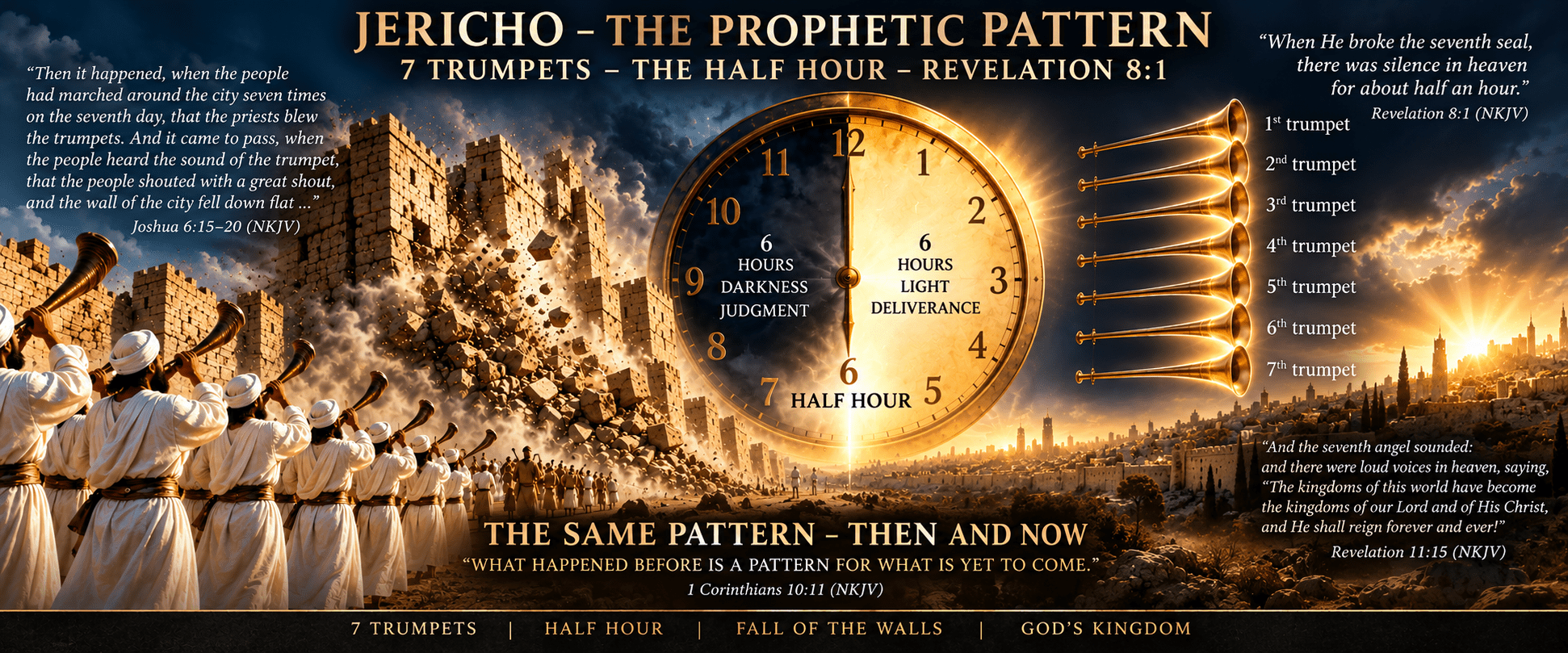
In Revelation 8:1 we read of a remarkable event: when the Lamb opens the seventh seal, heaven falls silent for about half an hour. Then seven angels appear and are given seven trumpets. This sequence is no accidental transition. The silence falls at the exact moment a new series of seven divine judgments begins.
When we place this event alongside the fall of Jericho in Joshua 6, an extraordinarily powerful biblical pattern emerges. At Jericho there are seven priests, seven trumpets, seven days, and on the seventh day seven processions around the city. After the seventh trumpet blast, Jericho’s wall falls. In Revelation we again see seven angels with seven trumpets, and at the seventh trumpet a decisive heavenly proclamation sounds: the kingdoms of the world become the kingdoms of our Lord and of His Christ.
Jericho thus stands before us as a prophetic pattern. What happens physically and locally at Jericho becomes visible in Revelation on a far greater scale: God intervenes, a power that has risen against Him is judged, and His kingship is made manifest.
Within this structure, the half hour also takes on meaning. A clock has twelve hours, and six is the midpoint of twelve. Six is literally half of twelve. When we place this alongside the biblical pattern of six versus seven, a striking line emerges: six preceding phases, then a transition, then the seventh and decisive phase.
We see this pattern at Jericho, at the seals, and at the trumpets. Six precedes seven. The seventh brings the breakthrough. The silence forms the turning point. Then the trumpet sounds. And finally the power of the adversary is broken and the kingship of God is made known.
Key conclusions
- The half hour of Revelation 8:1 falls at a decisive turning point.
- The seven trumpets of Revelation show a strong parallel with the seven trumpets at Jericho.
- At Jericho, six days form the preparation for the decisive seventh day.
- With the seals, the first six seals form a preceding series; the seventh seal opens the way to the seven trumpets.
- With the trumpets, the seventh trumpet brings the decisive proclamation of Christ’s kingship.
- The silence before the trumpets recalls the silence Israel had to keep before the decisive victory at Jericho.
- The number twelve is an important biblical number of order and fullness; six is half of that and forms its natural midpoint.
- The strongest connection is not that we must mathematically convert the half hour into six, but that Scripture repeatedly shows the pattern of six preceding units set against a decisive seventh unit.
In-depth explanation
1. The riddle of the half hour
Revelation 8 opens with an event that is easily overlooked. The Lamb opens the seventh seal, and silence falls in heaven.
Revelation 8:1
“And when he had opened the seventh seal, there was silence in heaven about the space of half an hour.”
Why does John specifically mention half an hour? He could simply have written that there was “a brief silence.” But he names a concrete span of time: about half an hour.
Moreover, that half hour does not stand at some random point in the book of Revelation. It stands precisely between the seventh seal and the seven trumpets.
The order is therefore:
6 seals → 7th seal → silence → 7 angels → 7 trumpets
The silence is thus a divine turning point.
Heaven falls silent before a new phase of judgment begins.
2. Twelve, six, and the midpoint
The Bible uses the number twelve remarkably often. Israel has twelve tribes. Yeshua chooses twelve apostles. The New Jerusalem has twelve gates and twelve foundations. The number twelve is thus bound up with God’s order, His people, and a complete divine structure.
When we picture a division into twelve, six is the exact midpoint:
12 ÷ 2 = 6
So the idea that six represents the middle or the half is logical in itself. When this is then laid alongside the prophetic structure of Revelation, we see that six consistently stands before the decisive seventh phase.
We should therefore not treat the half hour superficially, as merely “thirty minutes.” The half hour stands at a point where Scripture again confronts us with the pattern of a preceding series and a decisive seventh phase.
The Bible does not literally say, “the half hour means six.” But the pattern surrounding the half hour makes the connection with six and seven extraordinarily meaningful.
3. The pattern from six to seven
We find the clearest example in creation.
God works for six days, and the seventh day is set apart as a day of rest.
Genesis 2:2
“And on the seventh day God ended his work which he had made; and he rested on the seventh day from all his work which he had made.”
The pattern is:
6 → 7 → completion
We then find that same pattern again at Jericho.
4. Jericho: six days waiting for the seventh day
The fall of Jericho is one of the most striking Old Testament examples of God’s victory through trumpet blasts.
Israel had to march once around the city each day for six days.
Joshua 6:3
“And ye shall compass the city, all ye men of war, and go round about the city once. Thus shalt thou do six days.”
But on the seventh day, everything changes.
Joshua 6:4
“And seven priests shall bear before the ark seven trumpets of rams’ horns: and the seventh day ye shall compass the city seven times, and the priests shall blow with the trumpets.”
Here we see the pattern in its clearest form:
6 days → 7th day → 7 processions → 7 trumpets → breakthrough
This is not human numerology. It is stated plainly in the biblical narrative.
5. The silence before the victory
There is one more detail at Jericho that connects directly with Revelation 8.
Before the decisive moment, Israel was not allowed to shout or make any sound.
Joshua 6:10
“And Joshua had commanded the people, saying, Ye shall not shout, nor make any noise with your voice, neither shall any word proceed out of your mouth, until the day I bid you shout; then shall ye shout.”
So there is a period of silence before the decisive trumpets and the victory.
That is striking when we read Revelation 8:1:
seventh seal → silence in heaven → seven trumpets
Jericho gives us:
seventh day → silence → seven trumpets → fall of the city
The parallel is too clear to ignore.
6. The seven trumpets of Revelation
After the silence, John sees seven angels. They are given seven trumpets.
Revelation 8:2
“And I saw the seven angels which stood before God; and to them were given seven trumpets.”
The trumpets are then sounded one by one. Each blast brings a new phase of judgment upon the earth.
So this series is not simply seven random events. The seventh trumpet forms the climax of the series.
Here the pattern appears again:
1 → 2 → 3 → 4 → 5 → 6 → 7
The first six bring the world ever further under
God’s judgment. Then comes the seventh.
7. The seventh trumpet: the kingship of Christ
What happens at the seventh trumpet?
Revelation 11:15
“And the seventh angel sounded; and there were great voices in heaven, saying, The kingdoms of this world are become the kingdoms of our Lord, and of his Christ; and he shall reign for ever and ever.”
This is the decisive breakthrough.
At Jericho, the wall falls when the seventh trumpet sounds. In Revelation, at the seventh trumpet it is proclaimed that the kingdoms of the world belong to our Lord and His Christ.
So we see a prophetic pattern:
Jericho:
7th trumpet → wall falls → God’s people are victorious
Revelation:
7th trumpet → the world’s power is brought under Christ → Christ reigns
Jericho is thus a foreshadowing of a far greater reality.
The victory does not belong to human strength. The LORD makes the wall fall.
8. The ark of the covenant links the two pictures
At Jericho, the ark of the covenant is present. The priests with the trumpets march ahead of the ark.
That matters, because the ark represents God’s covenant and His presence among His people.
And what happens at the close of the seventh trumpet in Revelation?
Revelation 11:19
“And the temple of God was opened in heaven, and there was seen in his temple the ark of his testament…”
This is an extraordinarily powerful detail.
Jericho:
Ark → priests → trumpets → seventh trumpet → fall
Revelation:
Heavenly temple → angels → trumpets → seventh trumpet → Christ’s kingship → ark made visible
Scripture thus uses the same language once more: God’s presence,
His covenant, trumpet blasts, and victory.
9. Six seals, then the seventh seal
Now the pattern goes even deeper.
Before the seventh seal, the first six seals are opened.
When the seventh seal is opened, a new trumpet does not follow immediately. First, silence comes.
Only then are the seven trumpets given.
This gives us:
1st through 6th seal → 7th seal → silence → 7 trumpets
This closely resembles Jericho:
6 days → 7th day → silence → 7 processions → trumpets → fall
It is as though, in both cases, God first allows a full preceding
period to run its course before opening a new, decisive seventh phase.
10. The half hour as a prophetic turning point
Here the half hour returns.
A clock has twelve hours. The middle of twelve is six. When we regard six as the half and the midpoint, the half hour in Revelation 8:1 takes on a striking place within the larger pattern.
The half hour does not fall in the middle of some random event. It stands between the seventh seal and the seven trumpets.
We can therefore see the half hour as a prophetic moment of silence and transition.
The old section has closed. The next section stands ready to begin.
Six → silence → seven → trumpets → victory
We find this pattern at Jericho, in the seals, and in the trumpets.
11. The seventh is always the breakthrough
Scripture consistently distinguishes between the six preceding units and the seventh, decisive unit.
At creation:
6 days of labor → 7th day of rest
At Jericho:
6 days → 7th day → 7 processions → fall
With the seals:
6 seals → 7th seal → silence → trumpets
With the trumpets:
6 trumpets → 7th trumpet → Christ’s kingship
This is the pattern we must not miss.
12. Why Jericho is a key to Revelation
Jericho was the first great city Israel entered in the land God had promised His people. The victory did not come through human military superiority. God gave the city into their hand.
That principle returns in Revelation.
Christ’s ultimate victory does not come because humanity improves itself. It comes because God Himself intervenes.
The seventh trumpet does not announce the victory of man, but the victory of the King.
That is why the connection between Jericho and Revelation matters so much:
The wall of Jericho falls.
The powers of this world are broken.
Christ openly takes possession of His kingship.
13. The pattern at a glance
| Jericho | Revelation |
|---|---|
| 6 days | 6 seals / preceding series |
| 7th day | 7th seal |
| Silence | Silence in heaven |
| 7 priests | 7 angels |
| 7 trumpets | 7 trumpets |
| 7 processions | 7 trumpet judgments |
| 7th trumpet | 7th trumpet |
| Wall falls | The world’s kingdoms become Christ’s |
| Ark present | Ark of the covenant made visible |
14. The prophetic line
When we bring all this together, a clear line emerges:
6 → transition → silence → 7 → trumpets → breakthrough → kingship
The six forms the preceding phase. The silence marks the transition. The seven brings the decisive phase. The trumpet announces God’s intervention. And the final outcome is the victory of God’s Kingdom.
That is why the half hour of Revelation 8:1 is no minor detail.
It stands at the hinge point of the vision.
15. A warning against human calculation
There is one thing, however, we must understand clearly. The power of this study does not lie in constructing an elaborate calculation from which we can derive a future date.
The Bible gives us no instruction to convert the half hour into years, months, or days. The danger is that we go beyond what is written.
The power lies precisely in the biblical pattern.
Scripture itself gives us the building blocks:
six → seven
silence → trumpets
seventh trumpet → victory
Jericho → Revelation
We do not need to turn that into a human calendar to grasp the message.
Practical application
The significance of this prophetic structure is, in the end, not simply that we uncover a pattern. It points us to the King.
Jericho teaches us that victory does not come from human strength. Israel could not bring down the walls with its own weapons. God gave the victory.
Revelation teaches the same lesson on a global scale.
When the seventh trumpet sounds, it is not declared that humanity has finally improved the world. Instead, this is proclaimed:
Revelation 11:15
“The kingdoms of this world are become the kingdoms of our Lord, and of his Christ.”
That is the destination of history.
- Man does not, in the end, reign.
- Babylon does not, in the end, reign.
- The Antichrist does not, in the end, reign.
- The powers of this world do not have the final word.
Yeshua HaMashiach has the final word.
Summary
The half hour of Revelation 8:1 stands at an extremely important prophetic turning point. The seventh seal is opened, heaven falls silent, and then seven angels with seven trumpets become visible.
When we compare this with Joshua 6, a striking parallel appears. Jericho has six days of preparation, followed by the seventh day with seven processions and seven trumpet blasts. Then the wall falls.
Revelation uses that same fundamental pattern of seven trumpets. And at the seventh trumpet comes the decisive proclamation: the kingdoms of this world become the kingdoms of our Lord and of His Christ.
The idea that twelve represents a complete cycle, with six as its midpoint, gives a meaningful symbolic background to the half hour. But the deepest key does not lie in a human calculation. The key lies in the biblical pattern of six, silence, seven, trumpets, and divine victory.
Jericho is thus no coincidental old story set beside Revelation. It shows us how God announces His victory through trumpet blast, how the fortress of man falls, and how His people finally enter what God has promised.
What happened at Jericho on a small scale points ahead to the greater victory that Revelation reveals:
The trumpet sounds.
The power of the adversary is broken.
The King appears.
And the kingdoms of this world become
the kingdoms of our Lord and of His Christ.
Key Bible references
- Genesis 2:2–3 — six days and the seventh day.
- Joshua 6:3–5 — six days, seven priests, seven trumpets, and the seventh day.
- Joshua 6:10 — silence before the decisive moment.
- Joshua 6:15–20 — the seventh day, seven processions, trumpet blasts, and the fall of Jericho.
- Psalm 47:5 — God is gone up with a shout, the LORD with the sound of a trumpet.
- Isaiah 27:13 — the great trumpet.
- Matthew 24:31 — the great trumpet and the gathering of God’s elect.
- Revelation 6:1–17 — the first six seals.
- Revelation 8:1–6 — the seventh seal, the silence, and the seven trumpets.
- Revelation 8:7–13 — the first four trumpets.
- Revelation 9:1–21 — the fifth and sixth trumpets.
- Revelation 10:7 — the days in which the seventh angel shall sound.
- Revelation 11:15–19 — the seventh trumpet, Christ’s kingship, and the ark of the covenant.
- Revelation 21:12–14 — the twelve gates and twelve foundations of the New Jerusalem.
Closing
The pattern is, in the end, simple yet striking:
6 → silence → 7 → trumpets → wall falls → the King reigns.
Jericho shows us the pattern. Revelation brings that pattern to its worldwide and final fulfillment.
The seventh trumpet is no ordinary next step. It is the trumpet of the breakthrough.
And when that trumpet sounds, it is no longer a question of who will finally reign.
Lord Yeshua reigns.