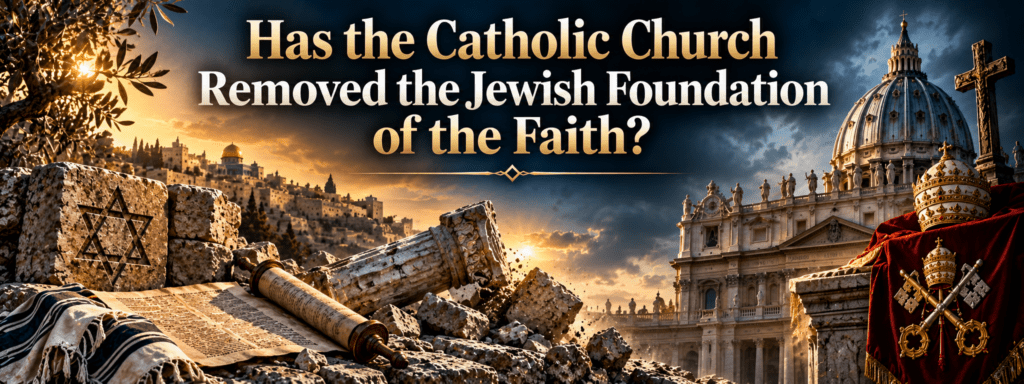
 Did the Catholic Church Remove
The Jewish Foundation of the Faith?
Summary
 History shows that the early church did not suddenly, but gradually, move away from its Jewish roots. This process took place over several centuries and was influenced by theological decisions, political circumstances, and social tensions. In this development, original Jewish elements became increasingly less visible within the growing Christian movement.
Key biblical practices such as the Sabbath and Passover were replaced by new forms such as Sunday worship and Easter. At the same time, the church began to see itself as the “new Israel,” which had major consequences for how the Jewish people were viewed. Instead of being considered a brother people, they were increasingly regarded as rejected or disobedient.
Although not all Jewish foundations disappeared — such as the Old Testament and faith in the God of Israel — it is historically clear that a strong movement arose to distance the faith from its original Jewish context.
- Jewish practices such as Sabbath and Passover were replaced
- The church began to see itself as the “new Israel”
- Jews were theologically rejected and marginalized
- Anti-Jewish ideas entered official doctrine and liturgy
In-depth explanation
1. The Separation Between Church and Judaism (1st–4th Century)
In the first centuries after Yeshua, there was still a clear connection between His followers and Judaism. The earliest believers were Jewish and lived according to the Torah. However, this connection gradually began to change. As the number of non-Jewish believers increased, tensions arose over which laws and practices still applied.
During this period, major shifts became visible. The Sabbath, observed for centuries on the seventh day, was replaced by gatherings on Sunday. Biblical Passover, deeply rooted in the Exodus, was disconnected from the Jewish calendar and replaced by Easter. The Torah increasingly came to be viewed as no longer binding for believers.
These changes were not only theological but also driven by social and political pressure. Jews were often viewed with suspicion within the Roman Empire, especially after revolts, and Christians sought to distinguish themselves. This resulted in a clear separation between church and Judaism.
Summary:
- The church developed the doctrine that it is the “new Israel,” known as replacement theology.
- The church took the place of Israel
- Jews were seen as disobedient or rejected
- Biblical promises were applied to the church
- From approximately the 2nd–4th century:
Source: lucepedia.nl
2. The Church as the “New Israel”
One of the most influential developments in church history is the rise of what is known as “replacement theology.” This teaching claimed that the church had taken the place of Israel in God’s plan. Where Israel was once seen as God’s chosen people, the church now became the bearer of God’s promises. This shift had profound consequences. The Jewish people were no longer viewed as central in God’s plan, but as a people who had rejected the Messiah. This created a theological framework in which negative perceptions of Jews could develop and spread. Promises from the Old Testament were increasingly interpreted spiritually and applied to the church, while their original context faded into the background. This further widened the gap between the church and Judaism and shaped Christian thinking for centuries.
Summary:
- “Replacement theology” (very important)
- The church = the “new Israel”
- This doctrine was standard until the 20th century
- Result:
- Jews = “rejected people”
- Church = replacement
- This is not opinion — this is historical consensus
Source: lucepedia.nl
3. Accusations Against the Jews
Within parts of the church, the belief developed that the Jewish people were responsible for the death of Jesus. This idea was repeated and reinforced over centuries and became part of preaching and teaching. Although the historical situation is more complex, this accusation led to deep-rooted mistrust toward Jews. Often, it extended beyond theology and had social and political consequences, contributing to an environment of exclusion, hostility, and even violence. This belief persisted for centuries and was only officially revised in the 20th century.
Summary:
- For centuries it was taught that Jews were responsible for Jesus’ death
- Jews were collectively blamed
- Consequences:
- Centuries of hostility
- Violence and pogroms
Source: julesisaacstichting.org
4. Anti-Jewish Elements in Liturgy
Negative references to Jews were not only present in theology but also in religious practice. In certain liturgical texts, Jews were described in terms suggesting they were unfaithful or blind to truth. Such language influenced how generations of believers viewed the Jewish people. Because liturgy plays a central role in religious life, it reinforced these perceptions over time.
- Good Friday prayer referred to “perfidis Judaeis” (“unfaithful / treacherous Jews”)
- This was part of official Catholic liturgy
Source: kuleuven.be
5. Church Laws Against Jews
Beyond theology, concrete measures were implemented that affected Jewish life. At the Fourth Lateran Council in 1215, rules were established restricting Jews’ rights and societal position. They were barred from public office and required to distinguish themselves from Christians. These regulations reinforced social separation and exclusion.
Summary:
- Institutional discrimination:
- No public offices
- Social separation
- Legal restrictions
Source: joodsamsterdam.nl
6. Social and Economic Exclusion
Due to religious and social pressures, Jews were restricted in many areas of life. They were excluded from professions and had limited economic opportunities. This led to dependency on specific roles, which in turn fueled stereotypes and further tension between communities.
Source: joodsamsterdam.nl
7. Persecution of Jews Within Christian Systems
Throughout history, Jews were repeatedly subjected to pressure and persecution within Christian-dominated societies. While not always uniform, patterns of distrust and exclusion are consistently visible.
A well-known example is the Spanish Inquisition, established under Catholic authority, which targeted converted Jews suspected of secretly practicing their former faith.
8. Was Everything Jewish Removed?
Not entirely. The church retained the Old Testament, belief in the God of Israel, and the concept of the Messiah. However, these elements were reinterpreted, often detached from their original Jewish context. This significantly altered their meaning and impact.
9. Change in the 20th Century
In 1965, the Second Vatican Council marked a turning point. The Catholic Church acknowledged that Jews could not be held collectively responsible for Jesus’ death and emphasized ongoing connection with the Jewish people.
Source: katholiekeraadjodendom.nl
Conclusion
History shows a clear development from connection to separation. What began as a movement within Judaism evolved into a distinct religion that, at times, stood in opposition to it. This process was shaped by theology, culture, and politics. While corrections have been made in modern times, understanding this history remains essential for grasping the roots of the faith today.
- The church developed long-standing anti-Judaic theology
- Jews were:
- Theologically rejected
- Socially restricted
- Sometimes persecuted
- The church consciously distanced itself from Jewish practices
- A clear shift occurred:
- From Jewish identity → to independent Christian identity