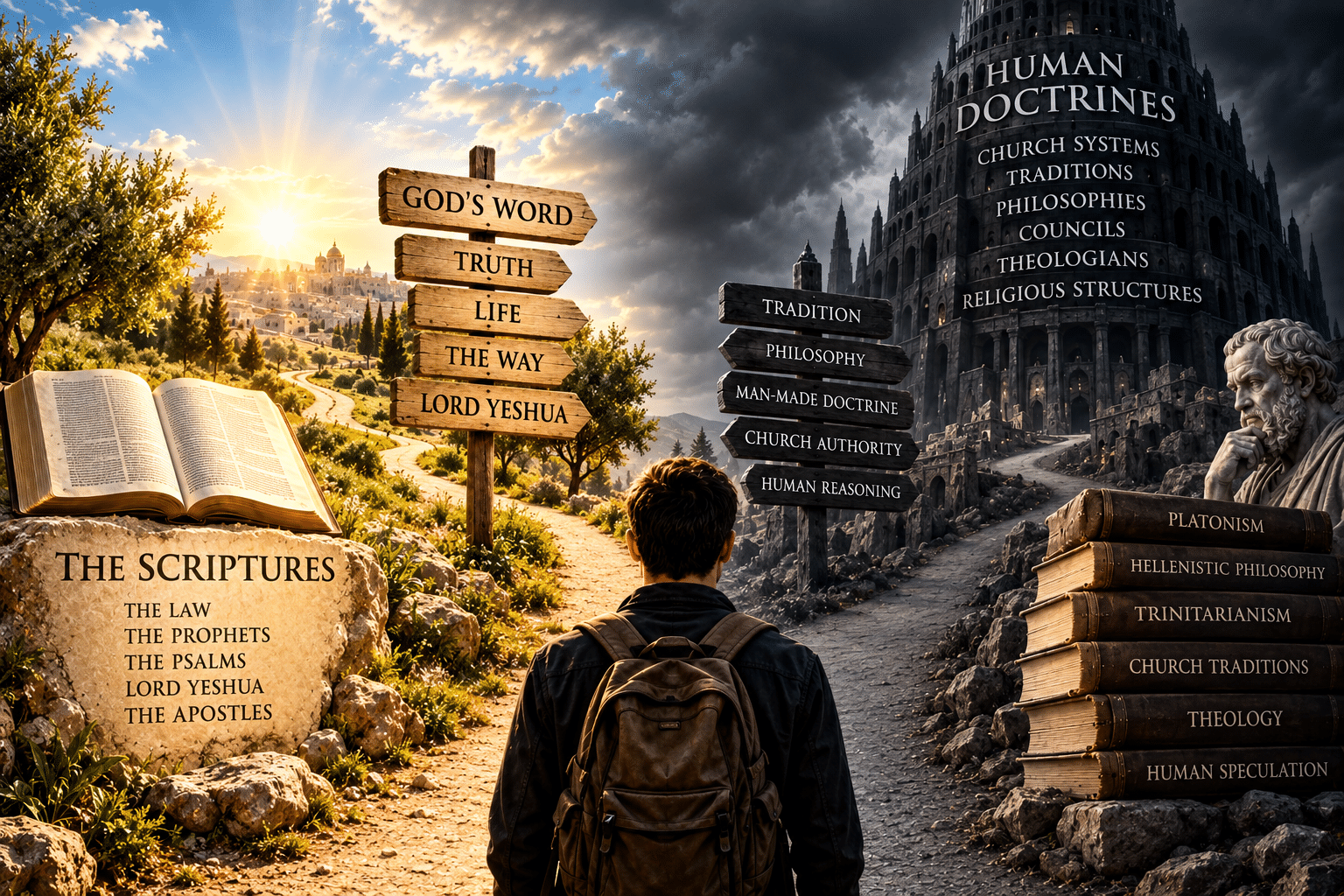
One Is Your Teacher
Test every teaching against the words of Lord Yeshua
Who ultimately decides what a believer should believe? A church? A theologian, a preacher, a council, a tradition, a religious system? Or should we go back to the One whom the Father Himself sent to make the truth known?
Lord Yeshua gave a remarkably clear answer to this. He warned His disciples not to let themselves be ruled by human titles and human spiritual authority, and He pointed them back to one Teacher.
Matthew 23:8-10 (WEB)
“But don’t you be called ‘Rabbi,’ for one is your teacher, the Christ, and all of you are brothers. Call no man on the earth your father, for one is your Father, he who is in heaven. Neither be called masters, for one is your master, the Christ.”
These words don’t mean that no one may ever teach anyone anything. Scripture itself speaks of teachers, elders, apostles and people who instruct others. Lord Yeshua’s point goes deeper: no human being may claim final spiritual authority over another person’s conscience. The source of truth remains God, and the Messiah He sent is our one and only Teacher.
People can teach, but only Lord Yeshua
decides what His disciples are to believe.
In-depth explanation
In-depth summary
Lord Yeshua’s teaching gives us a foundational principle for studying the Bible: we must not make any human teacher, church tradition, or theological system the final measure of truth. Lord Yeshua Himself says there is One who is our Teacher.
That means every teaching has to be examined. When someone claims a particular doctrine is essential to true faith, our first question shouldn’t be which church adopted it. We should start somewhere else:
Did Lord Yeshua actually teach this?
Then comes a second question:
Did His apostles receive this teaching, confirm it and pass it on?
So a teaching that Lord Yeshua never directly taught shouldn’t be accepted as truth automatically just because churches, councils or theologians formulated it later. That alone doesn’t prove the teaching is false. But it does mean it needs to be tested against Scripture again.
This distinction matters. The Bible doesn’t say that every truth must have been spoken word for word by Lord Yeshua Himself. The apostles went on to develop things that grew out of His teaching and the Scriptures. So a teaching shouldn’t be measured only against isolated sayings of Lord Yeshua, but against the whole of His teaching and the apostolic witness.
Still, the starting point is clear:
When a teaching is presented as a fundamental truth about God,
the Messiah or salvation, it is fair to ask where Lord Yeshua and the
apostles actually teach it.
Key conclusions
- Lord Yeshua calls Himself the Teacher of His disciples.
- No human teacher may take the place of His ultimate spiritual authority.
- Human teachers may explain Scripture, but what they teach must be tested against the words of Lord Yeshua.
- A church tradition doesn’t gain divine authority simply because it is old or widespread.
- A fundamental teaching must demonstrably line up with the teaching of Lord Yeshua and the apostles.
- What Lord Yeshua didn’t say directly isn’t automatically false, but it must be carefully examined in light of the whole of Scripture.
- Believers aren’t called to follow a human teacher blindly, but to seek the truth and test it.
A teaching isn’t true because it is old,
but because it agrees with God’s Word.
1. One is your Teacher
Lord Yeshua’s words in Matthew 23 come in a passage where He warns His disciples about religious leaders who crave human honour and spiritual status. He isn’t forbidding teaching. He is warning against lifting people up to a position where their word becomes the final say.
The difference is real. A teacher can say: “This is what I see in Scripture.” But a religious authority can say: “You must believe this because the church has decided so.”
The first invites you to look into it. The second can shut the inquiry down.
Lord Yeshua does exactly the opposite. Again and again He calls people to listen, to understand, to search, and to act on God’s truth.
So the principle of Matthew 23 isn’t “No one may ever teach anyone.” The principle is: no one may take the place of the ultimate Teacher.
2. Lord Yeshua came to make the Father known
Lord Yeshua’s teaching isn’t about founding a human religious school. He came from the Father and kept pointing to the Father.
John 17:3 (WEB)
“This is eternal life, that they should know you, the only true God, and him whom you sent, Jesus Christ.”
We see an important pattern here. Lord Yeshua speaks of His Father as the only true God, and of Himself as the One the Father sent. Within the line of thought explored on this website, that is foundational: the Father is the Source, and Lord Yeshua is the Messiah sent by the Father.
Lord Yeshua didn’t come to make people dependent on some later human theological tradition. He came to make the Father known and to open the way to Him.
John 14:6 (WEB)
“Jesus said to him, ‘I am the way, the truth, and the life. No one comes to the Father, except through me.’”
If Lord Yeshua Himself is the Way to the Father, we have to take His teaching with the utmost seriousness. That is exactly why it stands out when later theological systems develop doctrines that can’t clearly be found in what He taught.
3. Did Lord Yeshua teach the Trinity?
This is a concrete example of the principle. When the Trinity is claimed to be a fundamental truth about God, we can ask a simple question: where did Lord Yeshua teach this?
Nowhere does Lord Yeshua literally say:
“God consists of three co-equal persons.”
Nowhere does He say:
“I am the second Person of a Trinity.”
Nowhere does He say:
“The Holy Spirit is the third Person of God.”
Nor does He ever say that believing in a later trinitarian definition is necessary to be saved.
That doesn’t automatically make every text Trinitarians appeal to irrelevant. It means we have to examine whether their conclusion really follows from those texts. A teaching can’t be defended simply because a church system has taught it for centuries.
When a teaching is called fundamental, we may ask where
it is found in the teaching of Lord Yeshua and His apostles.
4. But didn’t the apostles teach anything new?
We need to be careful here. It would be wrong to say that only the words Lord Yeshua spoke out loud are valid. The apostles developed and applied His teaching further.
They proclaimed the meaning of His death and resurrection; for example, explained the relationship between law and grace, and applied Lord Yeshua’s words to real situations in the congregations.
That is why the test needs two layers:
- What did Lord Yeshua Himself teach?
- How did His apostles explain and apply that teaching?
And there is a third layer: how does the teaching relate to the earlier Scriptures, the Torah, the Prophets, and the Psalms?
Sound Bible study doesn’t start with one verse that confirms what we already think. The whole of Scripture has to be examined.
1 Thessalonians 5:21 (WEB)
“Test all things, and hold firmly that which is good.”
This fits the principle this website has always started from: teachings shouldn’t be accepted blindly, but carefully examined and tested against Scripture.
5. The Holy Spirit leads into the truth
Lord Yeshua also promised His disciples that the Holy Spirit would teach them and remind them of His words.
John 14:26 (WEB)
“But the Counselor, the Holy Spirit, whom the Father will send in my name, he will teach you all things,
and will remind you of all that I said to you.”
Notice what is happening here. The Holy Spirit isn’t presented as a means for people to invent new doctrines of their own. The Spirit brings Lord Yeshua’s words back to mind and teaches His disciples.
Within the theological framework of this website, the Holy Spirit is understood as the Spirit of Father God Himself: His presence, His power, His active nearness. That makes it all the more important to distinguish between human theology and what God is truly teaching.
The Spirit doesn’t lead away from Lord Yeshua. He leads us into the very truth
Lord Yeshua taught.
6. A teacher must never stand above Scripture
There is nothing wrong with listening to a preacher, Bible teacher, pastor, or researcher. God can use people to teach others.
The problem starts when the student stops checking for themselves.
That is when teaching turns into dependence.
A believer should be able to say:
“I value what this teacher says, but I need to look into it myself.”
That isn’t rebellion. It is biblical discernment.
The Bereans are actually praised because they examined even Paul’s preaching.
Acts 17:11 (WEB)
“Now these were more noble than those in Thessalonica, in that they received the word with all readiness of the mind, examining the Scriptures daily to see whether these things were so.”
If even Paul’s teaching had to be checked against the Scriptures,
how much more should later theological systems be examined?
7. What if a teaching is only formulated centuries later?
Here we need to draw an important line between developing an explanation and developing a new doctrine.
It is natural for believers through the centuries to try to understand difficult passages better. New words can sometimes help summarize an understanding that is already biblical.
But when a later formulation adds a new foundation that doesn’t clearly come from Scripture, that formulation has to be examined again.
The age of a doctrine doesn’t prove it true.
Nor does the fact that a doctrine was formulated later automatically prove it false.
The deciding question remains:
Is this teaching truly in line with what Scripture teaches,
with Lord Yeshua and with the witness of the apostles?
8. The danger of human authority
Throughout history, religious systems have developed elaborate doctrines. Those doctrines were then set down in creeds, catechisms, church decrees and dogmas.
It is easy for things to end up backwards. First there was Scripture. Then came interpretation. And then the interpretation became the lens through which Scripture was read.
That is exactly the order we need to avoid.
Scripture shouldn’t be bent to fit a system decided in advance. The system has to be tested against Scripture.
We shouldn’t read the Bible to defend our doctrine;
we should examine our doctrine to see whether it truly follows the Bible.
9. Lord Yeshua is not only our Teacher, but also our Way
Lord Yeshua’s teaching can’t be separated from who He is. He isn’t just someone passing on information. He is the Messiah sent by the Father.
He teaches us who the Father is. He teaches us how to live. He teaches us how to pray. He teaches us what love is. He teaches us about the Kingdom. He teaches us about repentance, forgiveness, obedience, and faith.
So it only makes sense that His words are our starting point when we examine later doctrines.
Within the wider theological line of this website, Lord Yeshua is also understood as the visible revelation of the invisible Father, without making Him equal to the Father Himself.
The Father is the Source. Lord Yeshua is the Son and Messiah sent by the Father. He reveals the Father and brings people to Him.
10. So how should we treat human teachers?
We don’t need to reject human teachers. We just need to know their place.
A teacher can help. A preacher can explain. A writer can offer insight. A researcher can bring historical background to light.
But none of them may take the place of Lord Yeshua.
So the right attitude isn’t:
“This preacher says it, so it must be true.”
But rather:
“This preacher says it. Let me check whether it matches Scripture.”
That is exactly the attitude we need when we examine old church traditions,
modern theology, and our own convictions too.
11. What does this mean for us personally?
In the end, this subject asks for more than an intellectual conclusion. It asks for a certain attitude toward the truth.
When we discover that a belief we have held for years doesn’t match Scripture, we need to be willing to look at it again.
That can be hard. A teaching can be bound up with family, church, culture, friends, or our own history. Yet truth doesn’t depend on how emotionally attached we are to a particular tradition.
Lord Yeshua doesn’t call His disciples to defend a religious system. He calls them to follow Him.
John 8:31-32 (WEB)
“If you remain in my word, then you are truly my disciples. You will know the truth,
and the truth will make you free.”
The order matters:
Remain in His word, be His disciple, know the truth, and be set free by it.
12. Human doctrines outside Scripture
Throughout history, many doctrines didn’t come directly from the Scriptures but were developed later within human religious systems. When a teaching isn’t taught by the prophets, Lord Yeshua and His apostles, but is only worked out later by church structures, human traditions, and philosophical frameworks, we need to test it against Scripture again. Especially when philosophical concepts are used to explain God, His nature, and His relationship to Yeshua, there is a real danger that human reasoning takes the place of what God has actually revealed. A doctrine doesn’t become true because a religious system has taught it for centuries, or because scholars can defend it with complex philosophical arguments. The standard remains the Word of God and the teaching it actually gives.
Putting it into practice
When you come across a teaching that is presented as fundamental, ask yourself these questions:
- Did Lord Yeshua Himself teach this?
- Did the apostles confirm it?
- Does it fit the Hebrew context of Scripture?
- Is it based on the whole of Scripture, or on a few isolated verses?
- Does it come straight from the Bible, or mainly from later tradition?
- Is the reader encouraged to look into it for themselves?
- Can the teaching be honestly tested without falling back on human authority as the final argument?
Once these questions have clear answers, there is room for genuine biblical discernment.
Search it out yourself. Test everything. Follow no one blindly. Let Lord Yeshua remain your Teacher.
Summary
Lord Yeshua says that One is our Teacher. With that, He gives us a foundational principle for all Bible study. People can teach, but no one may take the place of ultimate spiritual authority.
That is why every doctrine has to be examined. A teaching held by a church, a theologian, or a centuries-old tradition doesn’t automatically carry divine authority. Nor is a later formulation automatically false. The deciding question is whether it truly agrees with Scripture, the teaching of Lord Yeshua and the witness of the apostles.
This applies especially to major doctrinal systems such as the Trinity. When a doctrine is said to be necessary for knowing God rightly, we may ask where Lord Yeshua Himself taught it and how the apostles confirmed it.
The answer shouldn’t be settled by human authority, but by careful study of God’s Word.
Lord Yeshua came to make the Father known. He is the Way to the Father, the Truth, and the Life. So every teaching must ultimately be brought back to Him.
One is our Teacher: Lord Yeshua the Messiah.
So test every teaching against His words, the apostles and the whole of Scripture.
Frequently asked questions
Does “One is your Teacher” mean no one may ever teach anyone else?
No. Scripture itself speaks of people who teach. Lord Yeshua’s words mean that no human teacher may take the ultimate place of spiritual authority. People can serve as teachers, but what they teach has to be tested.
Does this mean everything Lord Yeshua didn’t literally say is automatically false?
No. The apostles developed and applied Lord Yeshua’s teaching further, so the apostolic witness has to be examined as well. The right principle isn’t “only the words Lord Yeshua literally spoke,” but “everything must agree with the teaching of Lord Yeshua, the apostles and the whole of Scripture.”
Why does it matter that Lord Yeshua Himself didn’t clearly teach a doctrine?
Because Lord Yeshua was sent by the Father and says Himself that He is the Teacher of His disciples. When a later doctrine is presented as absolute and fundamental, it is reasonable to ask why it can’t clearly be found in His teaching.
So should we not trust human preachers at all?
We can value what they teach, but we shouldn’t accept it blindly. Acts 17:11 shows that even Paul’s preaching was checked against the Scriptures. That is an example for every believer.
What should I do if my church teaches something different from Lord Yeshua?
Look into it carefully. Read the relevant passages in their context. Compare Scripture with Scripture, and look at the historical background where needed. In the end, let the truth of God’s Word decide, not church tradition.
So what is the most important question to ask about any doctrine?
The key question is: “Where does Scripture teach this, and how does it fit within the teaching of Lord Yeshua and His apostles?” That is a far more reliable question than “Which church teaches this?”