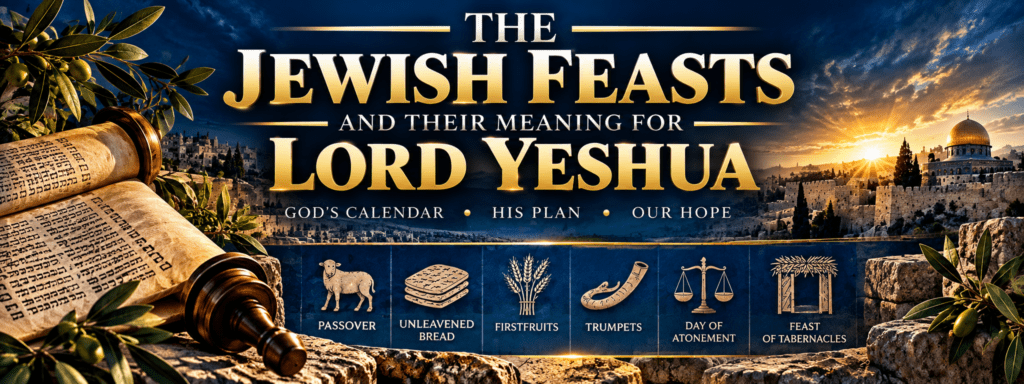
God’s Biblical Calendar Is No Coincidence
In-depth summary
The Bible contains a calendar of holy days that God Himself established. These days were not invented by Christians, nor were they originally Christian feasts. God gave these feasts to Israel. That is why they carry a distinctly Jewish and Hebrew character. At the same time, Scripture as a whole shows that their significance reaches far beyond the history of the Jewish people alone.
God Himself calls these days His appointed feasts. In Leviticus 23 they are not presented as human traditions, but as fixed times at which Israel was to gather before God.
Leviticus 23:2
The LORD spoke to Moses: Speak to the Israelites and say to them: These are the appointed feasts of the LORD, the holy assemblies, which you are to proclaim at their appointed time.
The feasts are tied to Israel’s exodus from Egypt, to the sacrifices, the priesthood, the harvest, the temple, and God’s presence among His people. They therefore belong to the biblical history of Israel.
But when the New Testament is read against the background of the Hebrew Bible, it becomes clear that the feasts also carry a more profound meaning. Paul writes that the feasts are a shadow of things to come, and that their reality is found in Christ.
Colossians 2:16-17
Therefore let no one judge you regarding food or drink, or regarding a festival, a new moon, or sabbaths. These are a shadow of the things to come, but the substance belongs to Christ.
The first feasts show this with particular clarity. Passover speaks of the lamb and the blood. Paul calls Yeshua our Passover Lamb. Firstfruits speaks of the first fruit of the harvest. Paul calls Yeshua the Firstfruits of those raised from the dead. Shavuot, the Jewish Feast of Weeks, finds its remarkable fulfilment in Acts 2 when the Holy Spirit is poured out.
The spring feasts thus reveal a clear line:
- Passover – redemption.
- Unleavened Bread – sanctification.
- Firstfruits – resurrection.
- Shavuot — Spirit and harvest.
Then come the autumn feasts. The Feast of Trumpets, the Day of Atonement, and the Feast of Tabernacles contains themes that connect strongly with God’s future acts: the trumpet, the coming of the King, atonement, judgment, joy, and finally God’s presence among His people.
Not every future event, however, can be directly tied to a specific feast day. The Bible gives us a pattern, not a licence to construct an exact end-times calendar.
The core message therefore remains simple:
The feasts are Jewish because God gave them to Israel. But their biblical meaning reaches beyond Israel alone. They make God’s plan of salvation visible and ultimately point to Yeshua HaMashiach.
In-depth explanation
Key Conclusions
- The biblical feasts were instituted by God Himself.
- God gave these feasts to Israel.
- That is why they carry a distinctly Jewish and Hebrew character.
- Scripture calls them the feasts of the LORD.
- Yeshua lived as a Jew within this biblical calendar.
- Passover points to Yeshua as the true Passover Lamb.
- Firstfruits points to His resurrection; Paul literally calls Him the Firstfruits.
- Shavuot/Pentecost is connected to the outpouring of the Holy Spirit.
- The autumn feasts contain strong prophetic themes.
- The Bible, however, does not give us the right to turn every feast into an exact date for a future event.
- The feasts are not the basis of our salvation.
- Yet their biblical meaning and Jewish origin must not be ignored.
- The feasts ultimately point to God’s plan of salvation and to Yeshua HaMashiach.
From God’s Appointed Feasts to the Messiah
To understand the meaning of the feasts properly, we must first return to their origin — not to later church history, and not to modern Christian traditions, but to Scripture.
- There we find their original meaning.
- There we find Israel.
- There we find the Hebrew calendar.
- And there we find the feasts that God Himself instituted.
[DIVIDER] 1. The Feasts Belong to the LORD and Were Given to Israel
Leviticus 23 is the key chapter for the biblical feast calendar. God speaks to Moses and instructs him to teach the Israelites about these days.
Leviticus 23:1-2
The LORD spoke to Moses: Speak to the Israelites and say to them: These are the appointed feasts of the LORD, the holy assemblies, which you are to proclaim at their appointed time.
This is significant. The Bible does not say that Israel invented these feast days. God institutes them.
At the same time, we must not erase their Jewish character. God gave these feasts to the Israelites. They are tied to the history of Israel, to the covenant, to worship, the sacrifices, and the Hebrew calendar.
That is why these feasts are both:
feasts of the LORD
and:
feasts that God gave to Israel.
That Jewish character therefore belongs to their biblical identity.
2. Passover – the Blood of the Lamb Brings Redemption
Passover begins with the exodus from Egypt. God announces His judgment on Egypt, but gives Israel a way for that judgment to pass over them. A lamb had to be taken. The blood had to be applied.
Exodus 12:13
The blood will be a sign for you on the houses where you are, and when I see the blood, I will pass over you. No plague will fall on you to destroy you when I strike the land of Egypt.
The blood of the lamb thus became a sign of protection and deliverance. Centuries later, John points to Yeshua.
John 1:29
The next day John saw Jesus coming toward him and said, “Behold, the Lamb of God, who takes away the sin of the world!”
Paul makes the connection even clearer.
1 Corinthians 5:7
For Christ, our Passover Lamb, has been sacrificed for us.
The meaning is therefore clear.
Yeshua is the Passover Lamb.
Passover, then, is not only about Israel’s deliverance from Egypt. It points to the far greater deliverance of humanity from the power of sin. Israel was freed by the blood of a lamb.
We are saved by the blood of the Lamb of God.
3. The Feast of Unleavened Bread – the Old Must Be Removed
Directly connected to Passover is the Feast of Unleavened Bread, in Hebrew Chag HaMatzah. Israel was to eat unleavened bread for seven days and remove all leaven from their houses.
Exodus 12:15
For seven days you are to eat unleavened bread. On the first day you must remove the leaven from your houses, for whoever eats anything leavened from the first day to the seventh day is to be cut off from Israel.
The removal of leaven thus became a visible expression of Israel’s obedience to God. Paul later uses this image for the life of believers.
1 Corinthians 5:6-7
Your boasting is not good. Don’t you know that a little leaven leavens the whole batch of dough? Get rid of the old leaven, so that you may be a new unleavened batch — as you really are. For Christ, our Passover Lamb, has been sacrificed for us.
Here we see an important order.
- First comes the blood of the Passover Lamb.
- Then the old must be removed.
That is also the pattern of the gospel.
Yeshua saves us from sin, and then calls us into a new life.
4. Firstfruits — Yeshua Is the Firstfruits of the Resurrection
The next significant moment is the feast of Firstfruits.
Israel was to bring the first sheaf of the harvest before the LORD.
Leviticus 23:10-11
When you enter the land I am giving you and reap its harvest, bring the first sheaf of your harvest to the priest. He is to wave the sheaf before the LORD so that it may be accepted on your behalf.
The first fruit represented the greater harvest still to come. Paul uses exactly this image when he speaks of the resurrection.
1 Corinthians 15:20
But now Christ has been raised from the dead, the firstfruits of those who have fallen asleep.
This is one of the clearest connections between the biblical feasts and Yeshua.
He is the Firstfruits.
His resurrection is the first fruit of the coming resurrection.
1 Corinthians 15:23
But each in his own order: Christ the firstfruits; then, at His coming, those who belong to Christ.
The significance is enormous. The resurrection of Yeshua is not merely proof that He is alive.
It is also the guarantee that death will ultimately be overcome for all who belong to Him.
5. Shavuot – the Jewish Feast of Weeks and the Holy Spirit
After Firstfruits comes Shavuot, the Feast of Weeks. In Greek, it is called Pentecost, Pentecost. This is why we need to understand that Pentecost was not originally a Christian holiday.
It was an existing Jewish feast.
Israel had already been celebrating Shavuot long before Acts 2. And it is precisely on this day that something extraordinary happens.
Acts 2:1-4
When the day of Pentecost arrived, they were all together in one place. Suddenly a sound like a rushing, violent wind came from heaven and filled the whole house where they were sitting. And tongues, like flames of fire that were divided, appeared to them and rested on each one of them. Then they were all filled with the Holy Spirit and began to speak in other tongues, as the Spirit gave them the ability.
The Spirit is poured out on the Jewish feast of Shavuot. What follows is an enormous spiritual harvest.
Acts 2:41
So those who accepted his message were baptized, and that day about three thousand people were added to them.
The pattern is striking.
- Firstfruits – the first fruit.
- Shavuot – the harvest.
Yeshua’s resurrection is followed by the outpouring of the Spirit and a great spiritual harvest.
6. The Spring Feasts Form One Clear Line
The first four parts of the feast calendar reveal a powerful continuity.
- Passover
The Lamb is sacrificed.
- Unleavened Bread
The old must be removed. - Firstfruits
The Firstfruits is raised. - Shavuot
The Holy Spirit is poured out and the harvest begins.
This sequence gives us a beautiful picture:
redemption → sanctification → resurrection → Spirit → harvest.
It is therefore too limited to view the feasts merely as ancient Jewish customs. Their origin is Jewish. Their meaning is biblical.
And their ultimate direction points to God’s plan of salvation.
7. The Autumn Feasts – Looking Ahead
After the spring feasts comes the seventh month.
In it, we find the three great autumn feasts:
- Yom Teruah – the Feast of Trumpets
- Yom Kippur – the Day of Atonement
- Sukkot – the Feast of Tabernacles
Here we find themes that connect strongly with future events. Scripture speaks of trumpets, God’s intervention, atonement, judgment, joy, and finally God’s presence among His people. We must, however, distinguish between biblical typology and an exact prophetic calendar. Scripture gives us strong connections. But it does not say that every future event will necessarily take place on the exact day of the corresponding feast.
That distinction matters.
8. Yom Teruah – the Feast of Trumpets and the Coming of the King
The Feast of Trumpets is connected in Leviticus 23 with the sounding of the trumpet.
Leviticus 23:24
Say to the Israelites: On the first day of the seventh month you are to have a day of rest, a sacred assembly commemorated with trumpet blasts.
The trumpet carries important meaning throughout the Bible.
It can be an announcement.
- A summons.
- A gathering.
- A warning.
- An announcement of a decisive moment.
The New Testament connects the coming of Yeshua with a trumpet.
1 Thessalonians 4:16
For the Lord Himself will descend from heaven with a shout, with the voice of an archangel, and with the trumpet of God, and the dead in Christ will rise first.
Paul also writes:
1 Corinthians 15:52
In a moment, in the twinkling of an eye, at the last trumpet. For the trumpet will sound, and the dead will be raised incorruptible, and we will be changed.
The Feast of Trumpets is therefore a powerful image of expectation and God’s future intervention. But we must not claim that Yom Teruah is thereby proven to be the exact date of the Second Coming.
The trumpet points us toward the expectation of the coming of the King.
9. Yom Kippur – the Day of Atonement
Yom Kippur is the most solemn day of Israel’s biblical calendar.
- On this day, atonement stood at the centre.
- The high priest entered the sanctuary.
- Blood was brought in.
- Atonement was made for the sins of the people.
Leviticus 16:30
Atonement is to be made for you on this day to cleanse you. You will be clean before the LORD from all your sins.
The letter to the Hebrews then shows how the priesthood and the sacrifices pointed forward to the work of Yeshua.
Hebrews 9:11-12
But when Christ appeared as high priest of the good things that are now here, going through the greater and more perfect tabernacle not made with hands (that is, not of this creation), He entered the most holy place once for all, not by the blood of goats and calves, but by His own blood, having obtained eternal redemption.
Yeshua, then, is not merely the sacrifice.
He is also the High Priest.
This is what gives the theme of Yom Kippur its full meaning.
But atonement and judgment belong together.
Acts 17:31
For He has set a day when He is going to judge the world in righteousness by the Man He has appointed. He has provided proof of this to everyone by raising Him from the dead.
The same Yeshua who saves will also judge.
For those who flee to Him, there is atonement.
Those who reject God’s grace will stand before the Judge.
10. Sukkot – the Feast of Tabernacles
The last of the great feasts is Sukkot, the Feast of Tabernacles.
Israel was to live in temporary shelters for seven days.
Leviticus 23:42-43
You are to live in shelters for seven days. All the native-born of Israel must live in shelters, so that your generations may know that I made the Israelites live in shelters when I brought them out of the land of Egypt. I am the LORD your God.
The feast reminds Israel that God led His people through the wilderness.
But it also carries a profound theme:
God dwells with His people.
We find that theme again at the beginning of the Gospel of John.
John 1:14
The Word became flesh and dwelt among us. We observed His glory, the glory as the One and Only Son from the Father, full of grace and truth.
The word “dwelt” here carries the image of tabernacle.
God came in Yeshua to dwell among His people. And ultimately, God’s plan of salvation ends with precisely this theme.
Revelation 21:3
Then I heard a loud voice from the throne: Look! God’s dwelling place is now among the people, and He will live with them. They will be His peoples, and God Himself will be with them and be their God.
That is the final destination.
God dwells with His people.
11. The Feast of Tabernacles and the Wedding Feast of the Lamb
It is tempting to call Sukkot directly the “wedding feast of the Lamb.” But that goes further than what the Bible literally states. Revelation speaks clearly about the marriage of the Lamb.
Revelation 19:7
Let us be glad, rejoice, and give Him glory, because the marriage of the Lamb has come, and His wife has prepared herself.
Nowhere, however, does Scripture literally say:
“Sukkot is the wedding feast of the Lamb.”
There are, however, important thematic parallels.
Sukkot speaks of:
God’s presence, joy, harvest, and dwelling with His people.
Revelation speaks of:
the Lamb, His bride, and God’s presence with His people.
It is therefore reasonable to see a typological connection.
But it is not reasonable to present a typological connection as if Scripture states it literally.
12. Yeshua Lived Within the Jewish Feast Calendar
The Jewish character of the feasts becomes even clearer when we look at the life of Yeshua.
- He did not live outside Jewish society.
- He lived within Israel.
- He knew the Torah.
- He went to the feasts.
John, for example, mentions the Feast of Tabernacles:
John 7:2
The Jewish Festival of Shelters was near.
Yeshua then went up to the feast.
John 7:10
After His brothers had gone up to the festival, then He also went up, not openly but secretly, as it were.
This matters.
We must not separate Yeshua’s Jewish identity from His identity as Messiah.
The Messiah of Israel came within the history of Israel.
- He was born a Jew.
- He lived as a Jew.
- He spoke from the Hebrew Scriptures.
- And He celebrated the biblical feasts of Israel.
13. Are Believers Required to Keep the Biblical Feasts?
Here we need to draw a clear distinction.
- The feasts are biblical.
- Their meaning is valuable.
- But they are not the basis of our salvation.
Paul warns believers not to judge one another over the observance of certain days.
Romans 14:5
One person considers one day to be above another day. Someone else considers every day to be the same. Each one must be fully convinced in his own mind.
He also writes:
Colossians 2:16
Therefore, let no one judge you regarding food or drink, or regarding a festival, a new moon, or sabbaths.
For this reason, the feasts must never be turned into a new legalistic system.
- No one is saved because he celebrates Passover.
- No one is justified because he observes Shavuot.
- No one receives eternal life because he keeps Sukkot.
Our salvation is by faith in Yeshua.
Ephesians 2:8-9
For you are saved by grace through faith, and this is not from yourselves; it is God’s gift — not from works, so that no one can boast.
But the opposite is equally mistaken. Because the feasts do not save us does not mean they are worthless.
God instituted them.
We are therefore free to study them, understand them, and use them to know God’s Word more deeply.
14. One Biblical Calendar – One Story of Salvation
When the feasts are viewed together, a remarkable pattern emerges.
| Season | Jewish Feast | What the Feast Depicts | Fulfilment in the Messiah (New Testament) | Key Text |
|---|---|---|---|---|
| Spring | Passover (Pesach) | A lamb is needed for protection from judgment. | Yeshua is the perfect Lamb of God who takes away sin. | John 1:29 / 1 Corinthians 5:7 |
| Spring | Unleavened Bread | Removing leaven (sin) and purification. | Yeshua was without sin, and His body lay in the tomb without decaying. | 1 Corinthians 5:8 |
| Spring | Firstfruits | The first fruit of the barley harvest announces the greater harvest. | Yeshua rose from the dead as the Firstfruits of the resurrection. | 1 Corinthians 15:20 |
| Spring | Shavuot (Feast of Weeks / Pentecost) | Harvest, assembly, and the giving of the Law (Torah) at Sinai. | The Holy Spirit is poured out and thousands of believers (the harvest) are added. | Acts 2:1-4 |
| Autumn | Rosh Hashanah (Feast of Trumpets) | The sounding of the shofar: a call to awaken, to gather, and a warning of judgment. | The rapture and the Second Coming of Yeshua at the sound of the last trumpet. | 1 Thessalonians 4:16 |
| Autumn | Yom Kippur (Day of Atonement) | Atonement for the people through the blood of the sacrificial animal. | Yeshua is the High Priest who brought definitive atonement with His own blood. | Hebrews 9:11-12 |
| Autumn | Sukkot (Feast of Tabernacles) | God temporarily dwelling with His people in the wilderness. | The ultimate fulfilment: God will dwell with His people forever on the new earth. | Revelation 21:3 |
Every feast on the calendar points with remarkable precision to the Messiah. The spring feasts were fulfilled to the exact day at His first coming. The autumn feasts prophetically anticipate the events surrounding His second coming.
The feasts are not separate from God’s plan of salvation.
Practical Application
1. Learn to Know the Biblical Feasts
- Read Leviticus 23.
- Learn the Hebrew names.
- Study their original meaning.
- Whoever knows the feasts also gains a more profound understanding of the world in which Yeshua and the apostles lived.
2. Do Not Strip Away Their Jewish Character
- These feasts were given to Israel.
- They belong to the history and identity of the Jewish people.
- Do not turn them into modern Christian holidays.
- They are Jewish because God gave them to Israel.
3. See the Messiah in the Larger Biblical Context
- Ask, for each feast:
- What does this feast reveal about God?
- What does it teach about His plan of salvation?
- What connection does the New Testament make with Yeshua?
4. Do Not Turn It Into a Legal Requirement
- Keeping a feast day makes no one righteous.
- Our righteousness is in Yeshua.
5. Use the Feasts to Understand God’s Word More Deeply
- The feasts can help us place events in the New Testament in their proper context.
- Shavuot, for example, becomes much clearer once we know what the Jewish Feast of Weeks meant.
- Passover deepens once we understand Exodus 12.
- Firstfruits gains more meaning when Leviticus 23 and 1 Corinthians 15 are read side by side.
6. Let the Feasts Lead to Yeshua
- The goal is not, in the end, to worship a calendar.
- The goal is to know the God of Israel better and to understand Yeshua as the Messiah more fully.
Summary
The biblical feasts are not a human invention. They are the feasts of the LORD. God gave them to Israel. That is why they carry a distinctly Jewish and Hebrew character. Whoever strips away that character removes the feasts from their original biblical context. But whoever says they are merely Jewish feasts and therefore no longer meaningful also misses an important part of God’s revelation. The New Testament shows that several themes of these feasts are directly connected to Yeshua.
- Passover brings us to the Lamb.
- Unleavened Bread brings us to the removal of the old.
- Firstfruits brings us to the resurrection.
- Shavuot brings us to the Holy Spirit and the harvest.
- Yom Teruah brings us to the trumpet and the expectation of God’s future intervention.
- Yom Kippur brings us to atonement, the High Priest, and judgment.
- Sukkot brings us to God’s presence and His ultimate dwelling among His people.
The feasts, then, are not the way to the Messiah, as though they themselves bring salvation.
Yeshua is the Way.
But the feasts help us see God’s plan of salvation.
- From the lamb in Egypt to the Lamb of God.
- From the first sheaf of the harvest to the Firstfruits of the resurrection.
- From the harvest to the outpouring of the Spirit.
- From the trumpet to the coming of the King.
- From the blood of atonement to the perfect sacrifice of the High Priest.
- From the shelter to the eternal dwelling of God with His people.
-
-
- The calendar tells one great story.
- God’s story of redemption.
- And at its centre stands Yeshua HaMashiach.
-
Frequently Asked Questions
1. Are these Jewish holidays?
Yes. They are deeply Jewish and Hebrew in character and were given by God to Israel. At the same time, the Bible calls them “the feasts of the LORD.”
2. Then why does the Bible call them the feasts of the LORD?
Because God Himself is their origin. Israel did not invent them as a human tradition. God gave them to His people.
3. Is Passover the same as Easter?
No. Passover (Pesach) is the biblical Hebrew feast instituted in Exodus 12. The word “Easter” refers to the later pagan Christian celebration and developed along a different historical path.
4. Is Yeshua our Passover Lamb?
Yes.
1 Corinthians 5:7
For Christ, our Passover Lamb, has been sacrificed for us.
5. Is Firstfruits the same as Pentecost?
No. Firstfruits and Shavuot are two distinct parts of the biblical feast calendar.
6. Why is Firstfruits significant for the resurrection?
Because Paul literally calls Yeshua the Firstfruits of those raised from the dead.
1 Corinthians 15:20
But now Christ has been raised from the dead, the firstfruits of those who have fallen asleep.
7. What is Shavuot?
Shavuot is the Jewish Feast of Weeks. In Greek, it is called Pentecost. In Acts 2, the Holy Spirit is poured out on precisely this feast.
8. Does the Feast of Trumpets point to the Second Coming?
The Feast of Trumpets carries strong themes of trumpet blasts, announcement, and expectation. The New Testament likewise connects the coming of Yeshua with a trumpet. But the Bible does not say that Yom Teruah is proven to be the exact date of the Second Coming.
9. Is Yom Kippur a picture of the final judgment?
Yom Kippur is primarily about atonement, the priesthood, and the sacrifice. The New Testament connects Yeshua with both atonement and future judgment. The prophetic connection is therefore strong, but should not be pressed further than Scripture allows.
10. Is Sukkot the wedding feast of the Lamb?
Not literally, according to Scripture. There are, however, strong thematic parallels between Sukkot and the biblical picture of God’s ultimate presence with His people and the marriage of the Lamb.
11. Are Christians required to keep these feasts?
The New Testament gives no basis for saying that anyone is justified by keeping these days. Romans 14:5 and Colossians 2:16 give freedom not to approach this legalistically.
12. Is it wrong, then, to celebrate these feasts?
No. A believer may study or observe the biblical feasts out of faith, gratitude, and a desire to understand God’s Word more deeply. It becomes wrong when it is made a condition for salvation or used to judge others.
13. Why is the Jewish character so important?
Because these feasts are part of Israel’s biblical history. They are tied to the Hebrew calendar, the Torah, the temple, the priesthood, the sacrifices, and God’s covenant with Israel. Without that background, we lose an important part of their meaning.
14. Did Yeshua celebrate the Jewish feasts?
Yes. The Gospels place Him squarely within the Jewish feast calendar. John 7, for example, describes His presence around the Feast of Tabernacles.
15. What is the most important message, in the end?
The feasts are not the final goal.
Yeshua is the final goal.
Whoever is in Him will not perish.
The feasts point to God’s plan of salvation, and God’s plan of salvation leads us to the Messiah.
- The feasts belong to the LORD.
- They were given to Israel.
- They are Jewish in character.
- They stand in the biblical calendar.
- And their deepest meaning points to Yeshua HaMashiach.