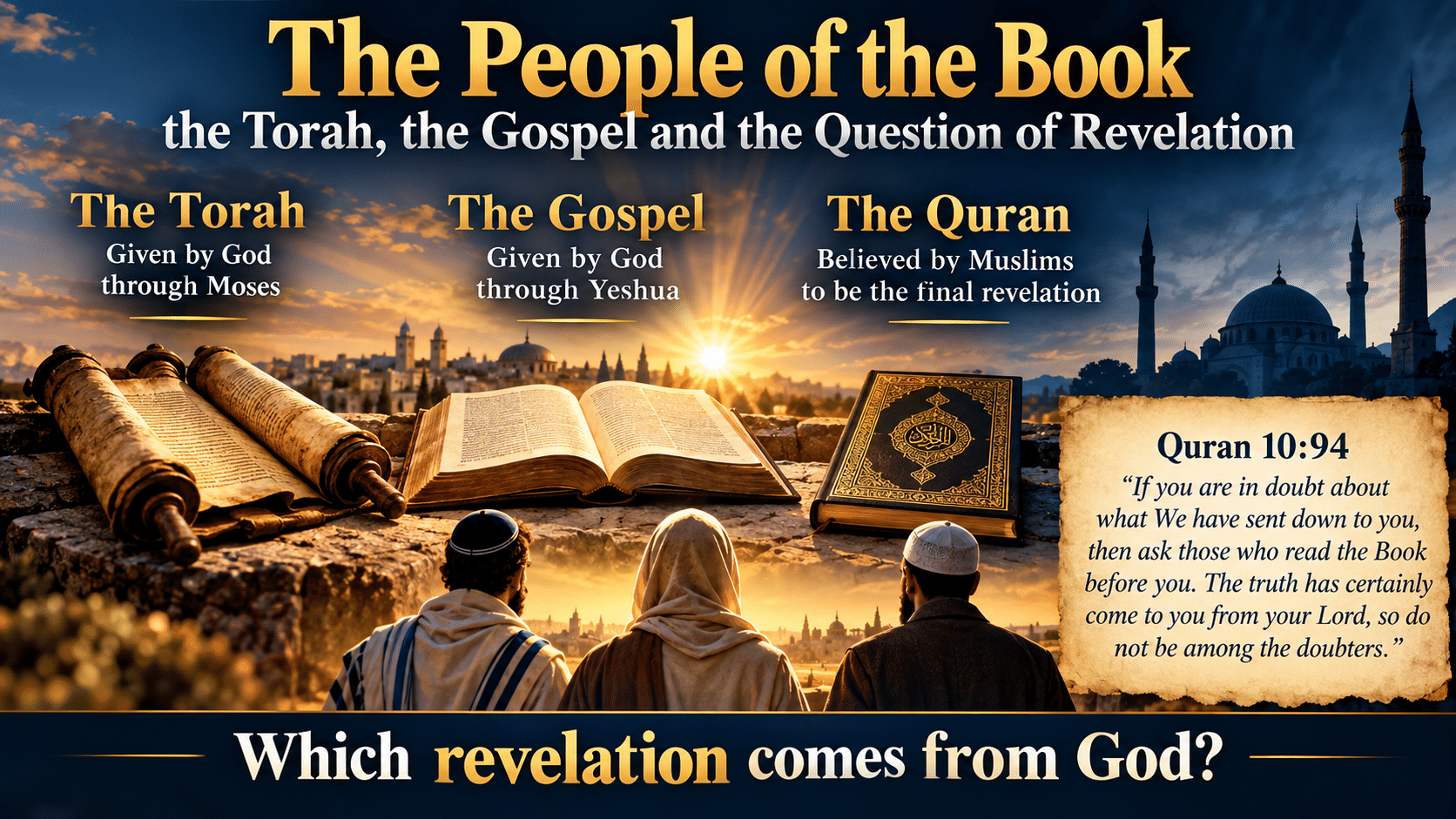
The People of the Book, the Torah, the Gospel, and the Question of Revelation
Introduction
When Christians and Muslims speak with each other about faith, the question often arises: which revelation truly comes from God? Muslims believe that the Quran is the final revelation from God. Christians believe that God has revealed His will through the prophets, through the Scriptures, and ultimately through Lord Yeshua the Messiah.
An important topic in this discussion is the reliability of the Bible. Many Muslims believe that the original Torah and the original Gospel came from God, but that these were later changed. Christians, however, point to various verses in the Quran that seem to confirm that the Torah and the Gospel were still available and had authority in the time of Muhammad. One of the most important verses is Quran 10:94. This article examines this issue from a Christian perspective. The purpose is not to attack anyone but to carefully examine what the Quran itself says and what questions arise from this.
In-depth explanation
Why Quran 10:94 is so important
Quran 10:94 reads:
“If you are in doubt about what We have sent down to you, then ask those who read the Book before you. The truth has certainly come to you from your Lord, so do not be among the doubters.”
This verse immediately raises an important question. Who are those who read the Book? The answer is simple.
Those are the Jews and Christians.
They already possessed the holy scriptures long before Muhammad appeared. The Quran thus refers to people who read the Torah and the Gospel. From a Christian perspective, a logical question immediately arises. Why would someone seeking certainty be referred to people who possess a falsified book? That would make little sense. Suppose a student doubts a math problem. The teacher says:
“Check the answer in that textbook.”
Then everyone assumes that the textbook is reliable. No one refers a student to a book known to be full of errors. That is precisely why Quran 10:94 is so often discussed.
The meaning of the People of the Book
The Quran regularly uses the expression “People of the Book”. This almost always refers to Jews and Christians. This is because they had already received revelations from God. According to the Quran, Moses received the Torah.
Quran 2:53 says:
“And when We gave Moses the Book.”
We also read:
Quran 3:3
“He has sent down to you the Book with the truth, confirming what preceded it. And He has sent down the Torah and the Gospel.”
The Quran thus clearly acknowledges that the Torah and the Gospel originally came from God. That point is not in dispute.
The real question is: Did these scriptures still exist in the time of Muhammad?
Quran 5:43 and the Torah
A striking verse is found in Quran 5:43.
“But how could they take you as judge while they have the Torah, in which is God’s judgment?”
This verse speaks about Jews consulting Muhammad. The Quran effectively responds, “Why do you come to Muhammad while you possess the Torah?”
That is a remarkable statement.
The Quran does not say:
“You once had a Torah.”
Nor does the Quran say:
“Your Torah has disappeared.”
The Quran says:
“You have the Torah.”
That seems to point to an existing, available text.
Quran 5:46 and the Gospel
Even more important is Quran 5:46.
“And We caused Jesus [Yeshua], son of Mary, to follow in their footsteps, confirming what was before him in the Torah, and We gave him the Gospel, in which there is guidance and light.”
Here the Quran describes the Gospel as:
- guidance;
- light;
- coming from God.
These are powerful words. The Quran speaks with respect about the Gospel. From a Christian perspective, a question, therefore, arises again. If the Gospel contains guidance and light, why would it later have become completely corrupt?
Quran 5:47 and a very important command
Immediately afterward follows a verse that is often overlooked.
Quran 5:47
“Let the people of the Gospel judge according to what Allah has sent down therein.”
This verse is extremely important. Christians are called to judge according to the Gospel. A command presupposes that the document in question is available. No one can live according to a book that has disappeared. No one can judge according to a text that no longer exists. From a Christian perspective, this verse therefore seems to confirm that the Gospel was still available and usable in the time of Muhammad.
Quran 5:68 and the call to Jews and Christians
An even stronger verse is found in Quran 5:68.
“Say: O people of the Book, you stand on nothing until you uphold the Torah and the Gospel and what has been sent down to you from your Lord.”
Here too we see the same pattern. Jews are referred to the Torah. Christians are referred to the Gospel. The Quran does not say that these books are worthless. The Quran does not say that these books have been destroyed. Rather, the Quran calls people to uphold these books. That raises a fundamental question.
Why would God command people to follow a falsified revelation?
What does this mean logically?
Let us simplify the reasoning.
Step 1. God gave the Torah.
Step 3. The people of the Book possess these scriptures.
Step 4. The Quran refers to these scriptures.
Step 5. The Quran calls people to follow these scriptures.
The logical conclusion seems to be that these scriptures still hold authority. This does not automatically mean that Christianity and Islam teach the same thing. But it does mean that the Quran seems to take the earlier revelations seriously.
The question of textual falsification
Many Muslims respond that the Bible was originally reliable but was later falsified. At first glance that sounds logical. But as soon as we examine that claim, new questions arise:
- When did that falsification happen?
- Who carried it out?
- Which texts were changed?
- What happened to the original texts?
- Why does the Quran still refer to the Torah and the Gospel?
- These questions are important because historical claims require evidence.
What does history teach?
Today researchers have access to thousands of ancient Bible manuscripts. These manuscripts come from various countries. They were copied by various groups. They date from centuries before Muhammad. Examples include:
- Codex Sinaiticus
- Codex Vaticanus
- Codex Alexandrinus
- In addition, there are many older papyri.
When researchers compare these manuscripts, it turns out that the core message of the New Testament has remained the same. This means that the Bible read today contains the same central message as the Bible that existed centuries before Muhammad.
The crucial question
This brings us to a fundamental question. If the Bible already existed before Muhammad in essentially the same form as today, when would the alleged falsification have taken place? If the falsification took place before Muhammad, why does the Quran refer to these scriptures? If the falsification took place after Muhammad, then where are the older manuscripts with different content? These questions form an important part of Christian apologetics.
What did Lord Jesus (Yeshua) say about the Scripture?
The Bible speaks with great confidence about God’s Word.
John 10:35:
“The Scripture cannot be broken.”
Matthew 24:35:
“Heaven and earth will pass away, but My words will certainly not pass away.”
Isaiah 40:8:
“The grass withers, the flower fades, but the Word of our God stands forever.”
According to the Bible, God preserves His Word. Christians see in this an essential reason why the Bible has been preserved through the centuries.
Why this topic is so important
The debate is ultimately not about paper, ink, or old manuscripts. It is about the question:
- how God reveals Himself.
- Can God preserve His revelation?
- Can God ensure that His message reaches humanity?
- Can God’s truth be lost?
Those are the real questions behind this discussion.
Preview of Part 2
In this first part we have seen that the Quran acknowledges the Torah and the Gospel, refers to the people of the Book and calls them to follow their scriptures. In the next part we examine an even more important topic. The Quran states multiple times that no one can change God’s words.
- What does that mean?
- Can God’s revelation be falsified?
- What does the Quran really teach about changing God’s Word?
- And how do these statements relate to the Islamic doctrine of tahrif, the alleged falsification of the Bible?
We will examine that step by step.
The end
>>Part 2. Can God’s Revelation Be Falsified?<<
biblehub
Quran Onlinehttps://quran.com/