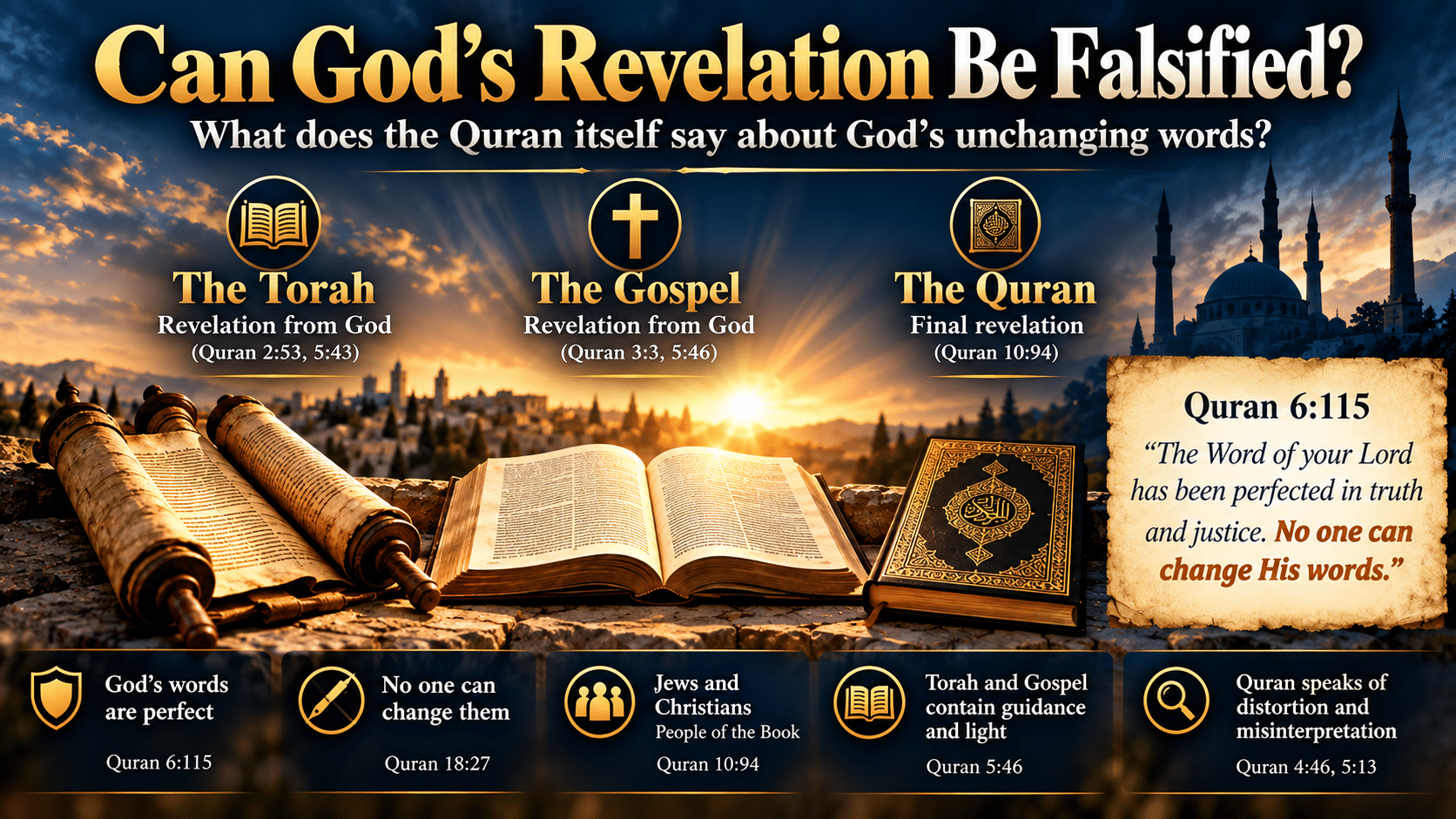
Can God’s Revelation Be Falsified?
Introduction
In Part 1 we saw that the Quran acknowledges the Torah and the Gospel as revelations from God. We saw that Quran 5:43 refers to the Torah, that Quran 5:47 calls Christians to judge according to the Gospel, that Quran 5:68 urges Jews and Christians to uphold their scriptures, and that Quran 10:94 refers to those who read the Book before Muhammad. Now we come to an even more fundamental topic. Can God’s Word be changed? This question stands central in virtually every discussion between Christians and Muslims about the reliability of the Bible. Many Muslims believe that the original Torah and the original Gospel came from God, but that these were later falsified. Christians often respond that the Quran itself states multiple times that God’s words cannot be changed. Therefore, it is necessary to carefully examine what the Quran really says.
Quran 6:115
One of the most important verses reads:
Quran 6:115
“The Word of your Lord has been perfected in truth and justice. No one can change His words.”
This is a very powerful statement. Note what it does not say.
It does not say:
“Most of God’s words cannot be changed.”
It does not say:
“Some of God’s words cannot be changed.”
It says:
“No one can change His words.”
That is an absolute statement.
Quran 18:27
A similar statement is found in:
Quran 18:27:
“No one can change His words.”
Again we see the same idea. God’s words are not subject to human power.
- No king.
- No priest.
- No scribe.
- No religious leader.
- No one.
From a Christian perspective, a simple question, therefore, arises. If no one can change God’s words, how can the Torah have been completely changed?
How can the Gospel have been completely changed?
What do God’s words mean?
Some try to limit these texts to God’s decrees or promises. But that does not fully solve the problem. Because the Quran itself calls the Torah and the Gospel revelations from God.
Quran 3:3:
“He has sent down the Torah and the Gospel.”
Quran 5:46:
“We gave him the Gospel in which there is guidance and light.”
When God gives a revelation, those are God’s words. If God’s words cannot be changed, tension arises with the idea that the content of God’s revelations would have been completely lost.
What is tahrif?
The Arabic word “tahrif” literally means to distort, change, or corrupt. Many Muslims use this word when speaking about the Bible. However, there exist different forms of tahrif.
- Tahrif of meaning.
- Tahrif of interpretation.
- Tahrif of text.
This distinction is important. The question is not what later scholars taught. The question is what the Quran itself teaches.
Quran 4:46
A verse that is often cited is:
Quran 4:46
“Among the Jews are those who distort words out of their context.”
Note carefully what is said here. The verse does not say that the text was rewritten. It says that words are taken out of their context. That is something different. Someone can misinterpret a text without changing the text itself.
Quran 5:13
A similar statement is found in:
Quran 5:13
“They distort words from their places.”
Again the verse speaks about distortion. Not necessarily about destroying the text. A preacher can misinterpret a Bible verse. This does not change the Bible text itself.
Quran 5:41
This verse too is often cited.
Quran 5:41
“They distort words after they have been put in their place.”
We see again the same pattern. The Quran accuses certain people of distortion. But nowhere does the verse say that the entire Torah has disappeared. Nowhere does it say that the Gospel was rewritten.
Quran 2:75
Another frequently cited verse reads:
Quran 2:75
“A party of them heard the Word of Allah and distorted it after they had understood it.”
Here too it concerns people distorting the truth. That is not the same as systematically destroying and replacing all manuscripts.
The difference between distorting and replacing
This distinction is crucial. Suppose someone misinterprets a traffic rule. Then he has not changed the law. He has misinterpreted it. Suppose someone takes a Bible verse out of context. Then he has not rewritten the Bible. He has distorted the meaning. Many Christian apologists point out that the Quran does speak about the distortion of meaning, but nowhere clearly teaches that the text of the Bible was worldwide replaced.
The problem of worldwide falsification
Let us assume that the Bible was truly completely falsified. Then historical problems immediately arise. The Bible already existed in:
- Israel;
- Syria;
- Egypt;
- Asia Minor;
- Greece;
- Italy;
- Ethiopia.
In addition, multiple languages existed:
- Hebrew;
- Aramaic;
- Greek;
- Latin;
- Syriac;
- Coptic.
To completely falsify the Bible, one would have to track down and change all manuscripts worldwide. There is no historical evidence for this.
The old manuscripts
Today researchers have access to thousands of manuscripts.
- Important examples are:
- Codex Sinaiticus
- Codex Vaticanus
- Codex Alexandrinus
In addition, there are many even older papyri. Some fragments date from the second century. That is hundreds of years before Muhammad. When these documents are examined, it appears that the core of the Gospel is present unchanged.
What do these manuscripts teach?
They teach that:
- Yeshua was crucified.
- Yeshua died.
- Yeshua rose from the dead.
- Yeshua is the Messiah.
- Salvation comes through Him.
These teachings already existed centuries before Islam. This means that they were not later added by Christians.
The challenge for the falsification theory
When did the falsification take place? If it took place before Muhammad, why does the Quran then refer to the Torah and the Gospel? If it took place after Muhammad, why do we then possess manuscripts from before Muhammad with the same message as today? These questions are rarely answered convincingly.
What does the Bible itself say?
The Bible teaches that God preserves His Word.
Isaiah 40:8:
“The grass withers, the flower fades, but the Word of our God stands forever.”
Psalm 119:89:
“Forever, O LORD, Your Word is settled in heaven.”
Matthew 24:35:
“Heaven and earth will pass away, but My words will certainly not pass away.”
John 10:35:
“The Scripture cannot be broken.“
From a Christian perspective, it would be strange if God promised to preserve His Word but then allowed His revelation to be completely lost.
An important logical problem
Suppose God cannot preserve His revelation. Then a serious problem arises:
- How then do we know which revelation is reliable?
- If the Torah could be lost, why not the Quran?
- If the Gospel could be lost, why not the Quran?
- If people can completely destroy God’s revelation, then in the end no revelation would be reliable.
This is precisely why the immutability of God’s Word is so important.
The Christian conclusion
When all the relevant verses are read together, the following picture emerges according to many Christian apologists.
The Quran acknowledges that:
- God gave the Torah.
- God gave the Gospel.
- The people of the Book possess these scriptures.
- No one can change God’s words.
At the same time, the verses speak about people who distort, misinterpret or conceal words. But that is something different from the worldwide destruction and replacement of God’s revelation. From a Christian perspective, the Quran therefore rather supports the preservation of God’s Word than its complete falsification.
Preview of Part 3. “How Does God Test a Prophet?”
In the next part we address the decisive question. How does God test a prophet?
We will examine:
We will then apply these biblical tests to every later claim of revelation. This will ultimately bring us to the central question of the debate: Who is Lord Yeshua really? And why do His death and resurrection form the heart of the Christian faith?
>>Part 3. “How Does God Test a Prophet?”<<
biblehub
Quran Onlinehttps://quran.com/