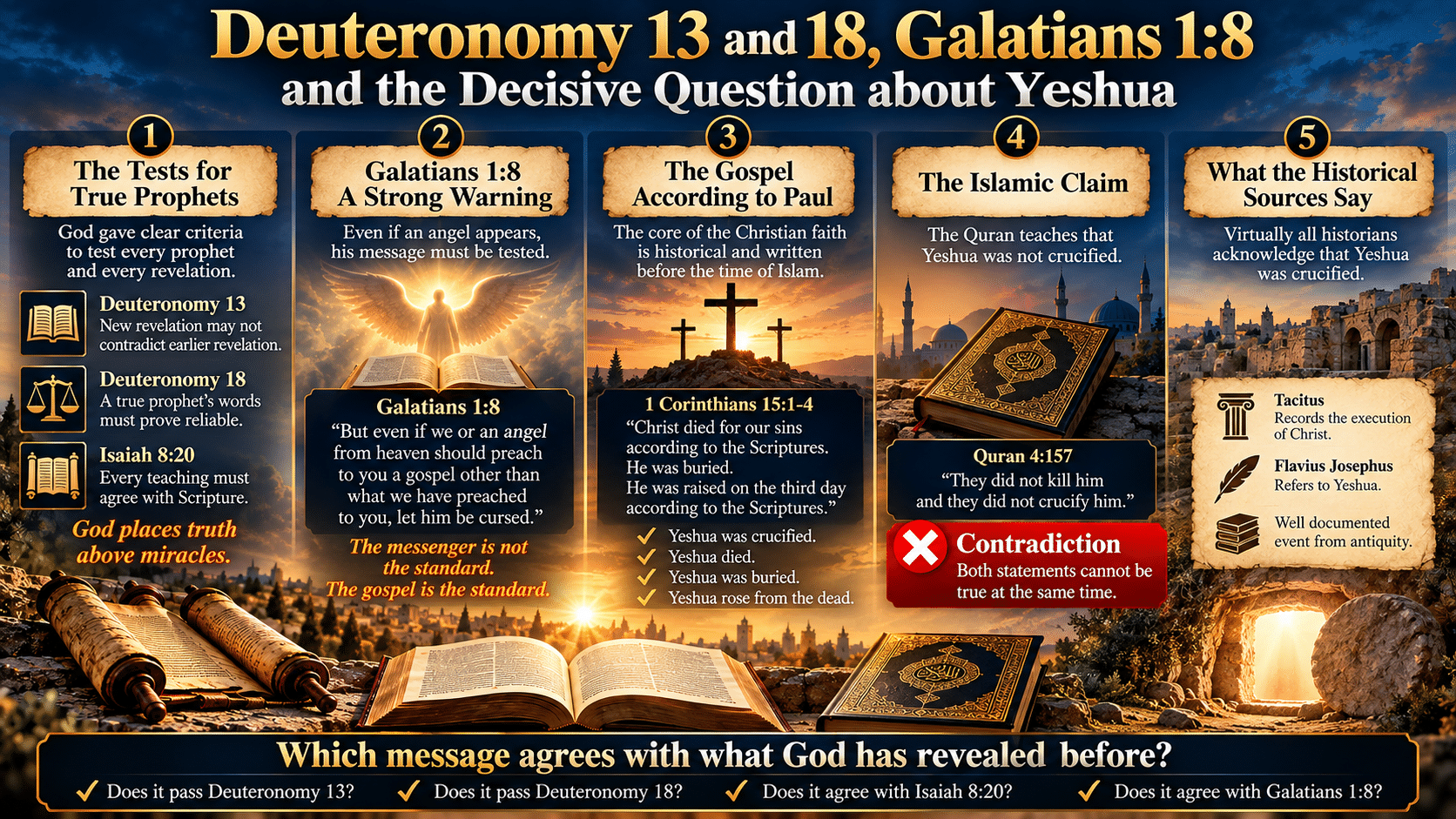
Deuteronomy 13 and 18, Galatians 1:8 and the
Decisive Question about Yeshua.
Introduction
In Part 1 we saw that the Quran acknowledges the Torah and the Gospel and calls the people of the Book to follow their scriptures.
In Part 2 we examined the Quran’s statements about the immutability of God’s Word. We saw that the Quran declares that no one can change God’s words and that the verses often cited about tahrif primarily speak about distortion of meaning and not clearly about worldwide textual falsification.
Now we come to the most important question of all. How does God determine whether someone is truly a prophet? This question is essential:
- Every religion can claim to possess a revelation from God.
- Every leader can claim to be a messenger of God.
- Every movement can say that it has found the truth.
But has God left humanity without a standard?
The Bible gives clear criteria by which every prophet and every revelation can be tested.
Why a test is necessary
Throughout history there have been countless people who claimed to speak on behalf of God. Some were sincere. Others were deceivers. Without an objective test, no one could know who speaks the truth. That is why God already gave clear guidelines in the days of Moses. These guidelines were given more than a thousand years before the coming of Jesus (Yeshua) and beyond two thousand years before our time.
Deuteronomy 13 – The first test
Deuteronomy 13 contains a remarkable warning.
Deuteronomy 13:1-3
“When a prophet arises among you, or one who has dreams, and he gives you a sign or wonder, and that sign or wonder comes to pass, and he says, ‘Let us go after other gods whom you have not known, then you shall not listen to the words of that prophet.”
This verse teaches something extraordinarily important. Miracles alone do not prove that someone comes from God. Even when a sign occurs, the message must be examined.
God places truth above miracles.
What does this mean?
Many people think, “If someone performs miracles, he must be from God.” The Bible teaches something different.
The question is not only “Can he perform a miracle?”
The question is, “Does his message agree with what God has revealed before?”
The first test: Deuteronomy 13:1-3
A new revelation may not contradict an earlier revelation.
The second test: Deuteronomy 18 –
God gives yet a second test.
Deuteronomy 18:22
“When that prophet speaks in the Name of the LORD and the word does not happen and does not come to pass, that is the word which the LORD has not spoken.”
Here we see a second principle. A true prophet speaks truth. His words prove reliable. God does not lie.
Therefore, a prophet who truly speaks on behalf of God will ultimately prove to speak truthfully.
The third test: Isaiah 8:20
The prophet Isaiah writes:
Isaiah 8:20
“To the law and to the testimony! If they do not speak according to this word, there will be no dawn for them.”
The meaning is simple. Every new message must be tested against earlier revelation. Scripture becomes the standard.
-
- Not human feelings.
- Not traditions.
- Not popularity.
- God’s revealed Word.
The example of the Bereans
We see the same principle in the New Testament.
Acts 17:11 says:
“They examined the Scriptures daily to see whether these things were so.”
Even the apostle Paul was checked. That is remarkable. Paul did not expect people to believe him blindly. He encouraged examination. His message had to agree with Scripture.
Galatians 1:8 – One of the strongest warnings in the Bible
Paul writes:
Galatians 1:8
“But even if we or an angel from heaven should preach to you a gospel other than what we have preached to you, let him be cursed.”
This verse is among the most important texts in Christian apologetics. Note what Paul says.
Even if:
- an apostle appears;
- a religious leader appears;
- a supernatural messenger appears;
- an angel appears;
His message must still be tested. The messenger is not the standard. The gospel is the standard.
Why Galatians 1:8 is so important
The Christian faith does not rest on a new revelation that replaces earlier revelation. It rests on God’s action in history. Paul says that the gospel has already been given. Therefore, every later claim must be tested against that gospel. That principle protects believers against deception.
What is the gospel according to Paul?
Paul summarizes the gospel in:
1 Corinthians 15:1-4
“Christ died for our sins according to the Scriptures. He was buried. He was raised on the third day according to the Scriptures.”
This forms the core of the Christian faith.
- Not a philosophy.
- Not a political movement.
- Not a religious system.
But the death, burial and resurrection of the Messiah.
The central question about Yeshua
Here Christianity and Islam ultimately part ways.
The Bible teaches:
- Yeshua was crucified.
- Yeshua died.
- Yeshua was buried.
- Yeshua rose from the dead.
The Quran teaches:
Quran 4:157
“They did not kill him and they did not crucify him.”
Here a direct contradiction arises. Both statements (1 Corinthians 15:1-4 and Quran 4:157)
cannot be true at the same time.
What do the historical sources say?
Virtually all historians today acknowledge that Yeshua was crucified.
- That applies to Christian historians.
- That applies to secular historians.
- That even applies to many non-Christian historians.
Among others:
- Tacitus: records the execution of Christ.
Also:
- Flavius Josephus: refers to Yeshua.
The crucifixion is among the best documented events from antiquity.
Why is the crucifixion so important?
Because the gospel rests on it. If Yeshua did not die, then there is no atonement. If Yeshua did not rise, then there is no victory over death.
Paul writes:
1 Corinthians 15:17
“If Christ has not been raised, your faith is futile.”
Christianity stands or falls with historical events.
The Messiah according to the prophets
Long before the coming of Yeshua, the prophets already spoke of a suffering Messiah.
Isaiah 53 says:
“He was wounded for our transgressions.”
Psalm 22 describes:
“They have pierced my hands and my feet.”
Zechariah 12:10 says:
“They will look on Me whom they have pierced.”
Christians see these prophecies fulfilled in Yeshua.
Why Christians hold to the Bible
Christians do not believe the Bible is reliable merely because the Bible says so itself.
They point to multiple lines of evidence:
- historical manuscripts;
- fulfilled prophecies;
- archaeological confirmations;
- eyewitness accounts;
- the resurrection of Yeshua;
- the unity of Scripture.
That is why Christians view the Bible as a reliable revelation from God.
The decisive question
In the end, every seeker faces the same choice.
- Which message agrees with what God has revealed before?
- Which message passes the test of Deuteronomy 13?
- Which message passes the test of Deuteronomy 18?
- Which message passes the test of Isaiah 8:20?
- Which message passes the test of Galatians 1:8?
These are the questions every sincere seeker must examine.
A personal invitation
Examine the Scriptures yourself.
- Read the Torah.
- Read the Psalms.
- Read the prophets.
- Read the Gospels.
- Read the words of Lord Yeshua.
- Test every claim carefully.
- Do not blindly follow what others say.
- Examine for yourself.
Truth need not fear examination.
Conclusion
The Bible teaches that God has given His people clear tests to distinguish truth from error:
Miracles alone are not sufficient.
Religious conviction alone is not sufficient.
An appeal to an angel is not sufficient.
Every message must be tested against God’s earlier revelation.
According to Deuteronomy 13, new revelation may not contradict earlier revelation.
According to Isaiah 8:20, every teaching must agree with Scripture.
According to Acts 17:11, believers must examine everything.
According to Galatians 1:8, even a message from an angel must be rejected when it deviates from the gospel.
For Christians, that test ultimately leads to one conclusion.
The Scriptures point to Lord Yeshua the Messiah.
His death was foretold.
His resurrection was foretold.
His coming was foretold.
He is the center of the prophets, the center of the gospel and the center of God’s plan of redemption.
Therefore, the invitation of Lord Yeshua remains the same today: “I am the Way, the Truth and the Life. No one comes to the Father except through Me.” John 14:6
Therefore examine the Scriptures. Test all things. Hold fast to what is good. And follow the truth, wherever it leads.
biblehub
Quran Onlinehttps://quran.com/