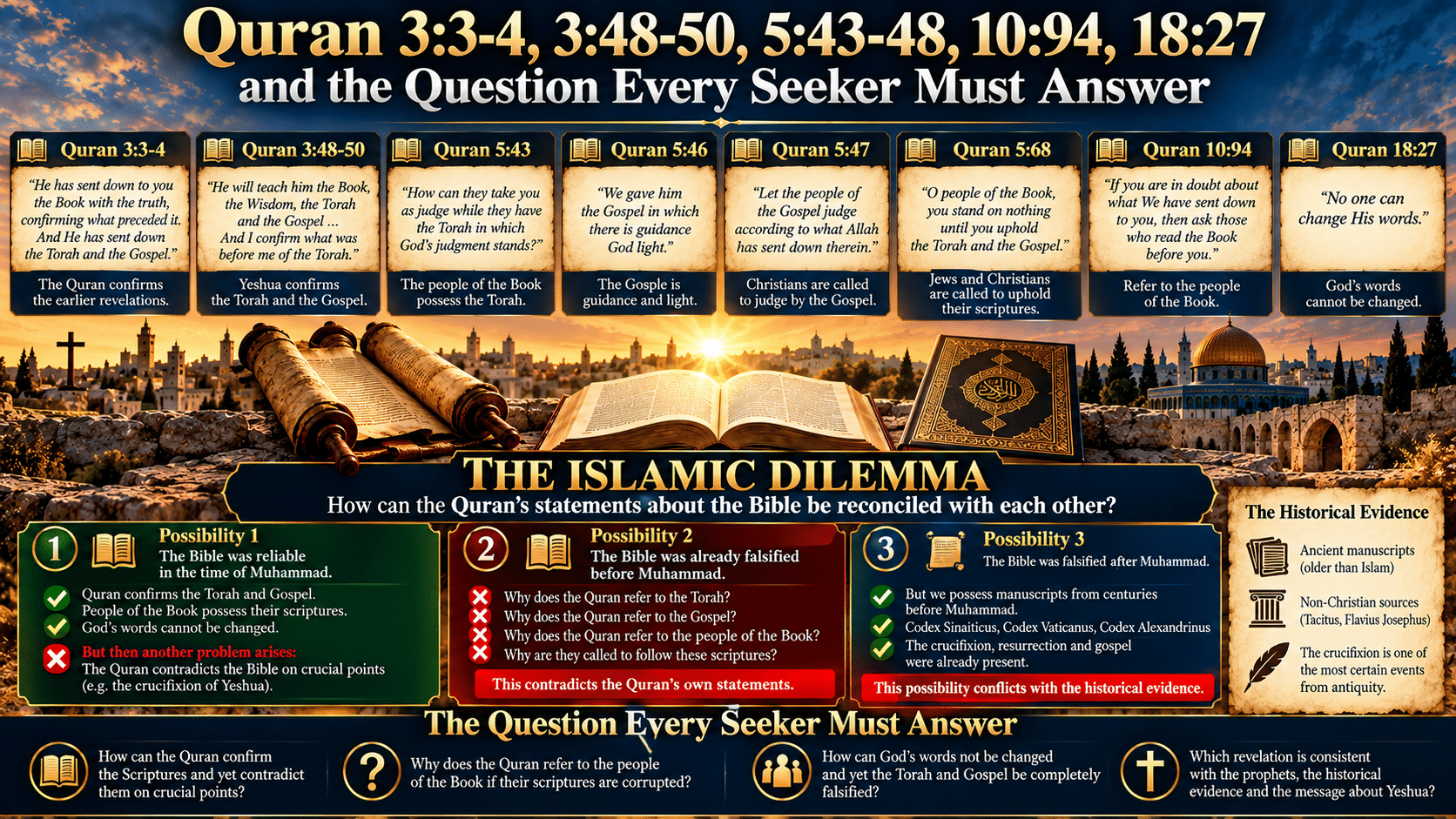
Quran 3:3-4, 3:48-50, 5:43-48, 10:94, 18:27, and
the Question Every Seeker Must Answer
Introduction
In the previous parts we looked at what the Quran says about the Torah, the Gospel, and the unchanging nature of God’s Word. Three things kept coming back: the Quran acknowledges the earlier revelations, it addresses the people of the Book as people who hold God’s revelation in their hands, and it says more than once that no one can change God’s words.
Put those statements side by side and you arrive, almost by necessity, at what is often called the “Islamic Dilemma”. Christian apologists such as GodLogic and Sam Shamoun use the term for a question that is hard to avoid: how do the Quran’s statements about the Bible fit together? This is not an attack on Muslims. It is an honest, logical question, and it deserves an honest answer.
In-depth explanation
What is the Islamic Dilemma?
At its core, the argument is not complicated. According to the Quran:
- The Torah comes from God.
- The Gospel comes from God.
- God’s words cannot be changed.
- The people of the Book possess their scriptures.
- The people of the Book are called to follow those scriptures.
At the same time, the Quran departs from the Bible’s teaching on a few essential points. That is where the problem lies:
- If the Bible is reliable, problems arise for the Quran.
- If the Bible is not reliable, problems arise for what the Quran itself says about it.
That is the heart of the argument.
What the Quran itself says
♦ Quran 3:3-4
One of the key passages appears right at the start of the third surah:
Quran 3:3-4
“He has sent down to you the Book with the truth, confirming what preceded it. And He has sent down the Torah and the Gospel.”
Notice that one word: confirming. The Quran does not present itself here as a book that corrects or replaces earlier revelations, but as one that confirms them. And that immediately raises a question.
How can a book confirm something while contradicting its very core?
What does “confirming” mean?
Think about how we normally use the word:
- When an accountant confirms a document, he vouches for its accuracy.
- When a judge confirms a statement, he declares it reliable.
- When a witness confirms a story, he backs that story up.
Confirming does not normally mean:
“I agree with everything, except the most important parts.”
For a Christian, then, this is not a side issue. It is a fundamental question.
♦ Quran 3:48-50
About Yeshua we read:
Quran 3:48
“He will teach him the Book, the Wisdom, the Torah and the Gospel.”
According to the Quran, Yeshua Himself confirms the Torah that was already there before Him:
Quran 3:50
“And I confirm what was before me of the Torah.”
The pattern is the same every time: the revelations build on one another, and what comes later confirms what was already there.
♦ Quran 5:43
We came across this verse earlier:
Quran 5:43
“How can they take you as judge while they have the Torah in which God’s judgment stands?”
For the idea that the text was completely falsified, this is an awkward verse. Why would the Quran point to the Torah as the place where God’s judgment can be found, if that Torah could no longer be trusted? It would make little sense.
♦ Quran 5:46
Quran 5:46
“We gave him the Gospel in which there is guidance and light.”
The verse does not say that the Gospel once contained guidance and was later lost. It describes it as a book in which guidance and light are to be found.
♦ Quran 5:47
Quran 5:47
“Let the people of the Gospel judge according to what Allah has sent down therein.”
For the theory that the Bible was completely falsified, this remains one of the hardest verses. Christians are told to judge by the Gospel. But how do you judge by a book that no longer exists?
♦ Quran 5:68
Quran 5:68
“O people of the Book, you stand on nothing until you uphold the Torah and the Gospel.”
Once again, Jews and Christians are pointed to their own scriptures. Not to a lost original, and not to some version nobody knows, but to the books they actually had in their hands.
♦ Quran 10:94
Which brings us back to the verse at the centre of this whole series:
Quran 10:94
“If you are in doubt about what We have sent down to you, then ask those who read the Book before you.”
The question has not changed. Why would the Quran send someone who doubts to the people of the Book, if their scriptures were corrupt? A corrupt source is not a reliable witness.
♦ Quran 18:27
Quran 18:27
“No one can change His words.”
For the idea that God’s revelation was lost, this may be the biggest challenge of all. If no one can change God’s words, how could the Torah have been completely changed? And the Gospel?
The usual Muslim answer: tahrif
To be fair, the other side deserves to be heard here. Many Muslims answer the dilemma with the doctrine of tahrif: the idea that earlier scripture was corrupted. They usually point to verses such as these:
Quran 2:79
“Woe to those who write the Book with their own hands and then say: ‘This is from Allah.’”
Quran 5:13
“They distort words from their proper places.”
Quran 3:78
“There is a group among them who twist the Book with their tongues.”
What often goes unmentioned is that Islamic tradition itself has never held a single view of what tahrif means. Broadly, there are two positions. The first is corruption of the meaning (tahrif al-ma’na): the text remained intact, but Jews and Christians interpreted it wrongly. The second is corruption of the text itself (tahrif al-nass): the words were actually changed.
The first view goes back to early authorities. Sahih al-Bukhari, for example, records a saying attributed to Ibn Abbas: no one can remove a word from God’s books, but people twist their meaning. The second view became widespread later and was argued forcefully by the Andalusian scholar Ibn Hazm in the eleventh century. Many Muslims today add a further point: the Torah and the Gospel the Quran speaks of are the original revelations given to Moses and Yeshua, not the Bible as we know it.
What does this answer solve?
It is a serious answer, and it deserves a serious look. But it runs into problems of its own:
- Corruption of meaning does not solve the dilemma; it sharpens it. If the text was preserved, then the crucifixion and the resurrection are still in it.
- The verses about distortion speak of a group, not of the whole book. Quran 2:79 and 3:78 describe some people writing or twisting things in a specific setting. They do not say the Torah or the Gospel was lost.
- Quran 5:13 and 5:43 are in the same surah. The chapter that speaks of distorting words is also the chapter that says the Jews have the Torah with them, with God’s judgment in it.
- The Quran speaks of the Torah and Gospel as present. It describes them as something the people of the Book have with them in Muhammad’s own time (5:43, 5:47, 7:157). An original that vanished centuries earlier does not fit that picture.
The tahrif answer deserves respect. But the more strictly it is applied, the harder it becomes to reconcile with what the Quran itself says about the Torah and the Gospel.
The three possibilities
Read all these verses together and you are left with really only three options.
Possibility 1
The Bible was reliable in Muhammad’s time. That solves a lot, but it immediately creates a new problem, because the Bible teaches that:
- Yeshua was crucified.
- Yeshua died.
- Yeshua rose from the dead.
The Quran, however, denies the crucifixion (Quran 4:157) and gives a very different picture of how Yeshua’s life on earth ended.
Possibility 2
The Bible had already been falsified before Muhammad. But then new questions arise:
- Why does the Quran refer to the Torah?
- Why does the Quran refer to the Gospel?
- Why does the Quran refer to the people of the Book?
- Why are they called to follow these scriptures?
Possibility 3
The Bible was falsified after Muhammad. This option runs aground on the historical evidence. We have manuscripts that are centuries older than Muhammad, and they contain the same core message that is still in the Bible today.
The manuscripts speak
A few important examples:
- Codex Sinaiticus (4th century)
- Codex Vaticanus (4th century)
- Codex Alexandrinus (5th century)
On top of these there are even older papyri. All of these documents predate Islam, and anyone who examines them will find:
- the crucifixion;
- the resurrection;
- the expectation of the Messiah;
- the gospel.
These teachings were there long before Muhammad.
The question of the crucifixion
This is where we reach the heart of the discussion. The crucifixion of Yeshua is not a side story in the Bible; you find it everywhere:
- The Gospels tell of it.
- The apostles teach it.
- The first Christians believed it.
- The oldest manuscripts contain it.
- The earliest church history bears witness to it.
Non-Christian sources confirm it too
Among others, the Roman historian Tacitus and the Jewish historian Flavius Josephus refer to Yeshua and His death.
| Historical Source | Passage | Subject |
|---|---|---|
| Tacitus | Annals 15.44 | Christus, executed under Pontius Pilate, and the Christians in Rome |
| Josephus | Jewish Antiquities 18.3.3 | The passage about Yeshua, known as the Testimonium Flavianum |
| Josephus | Jewish Antiquities 20.9.1 | James, identified as the brother of Yeshua, who was called Christ |
One honest note on Antiquities 18.3.3: most historians believe the core of the passage is authentic, but that Christian additions were inserted into it later. Even without those additions, the passage still records that Yeshua was condemned under Pilate.
That is why historians regard the crucifixion as one of the most certain facts of antiquity.
Why this matters so much
Because the gospel rests on it. Paul puts it plainly:
1 Corinthians 15:3
“Christ died for our sins according to the Scriptures.”
And:
1 Corinthians 15:17
“If Christ has not been raised, your faith is futile.”
Christianity stands or falls with these events.
The question every Muslim must ask themselves
- If the Quran confirms the Torah…
- If the Quran confirms the Gospel…
- If the Quran says that no one can change God’s words…
- If the Quran calls Christians to live by the Gospel…
- If the Quran sends those in doubt to the people of the Book…
Why, then, should a Muslim regard the Bible as unreliable?
That is the central question.
The question every Christian must be able to answer
Believing is not enough on its own. Christians also need to understand why they believe. A few questions worth asking yourself honestly:
- Can you explain why the Bible is reliable?
- Can you explain why God’s Word has been preserved?
- Can you explain why the resurrection matters historically?
- Can you explain why the prophets point to Yeshua?
Every Christian should take the time to study these questions.
The conclusion
When the relevant verses of the Quran are placed side by side, many Christian apologists see a fundamental tension:
- The Quran confirms the earlier revelations.
- The Quran refers to the people of the Book.
- The Quran calls them to follow their scriptures.
- The Quran declares that God’s words cannot be changed.
And yet, on crucial points, the message of the Quran departs from the message of the Bible. That is why many Christian researchers conclude that the Quran does not refute the Bible, but in fact, indirectly, confirms it. For Christians, the call of Lord Yeshua remains central:
John 5:39
“Search the Scriptures.”
And the call of Paul:
1 Thessalonians 5:21
“Test everything, hold fast to what is good.”
Truth has nothing to fear from investigation. God’s Word stands firm. And every sincere seeker is invited to examine the evidence carefully and come to a conclusion of their own.
biblehub
Quran Online https://quran.com/